
Audit One Mines Cashout Target
This version is intentionally limited to paytable verification. It does not duplicate the full calculator, payout tools or brand presets maintained on MinesCalc.com.
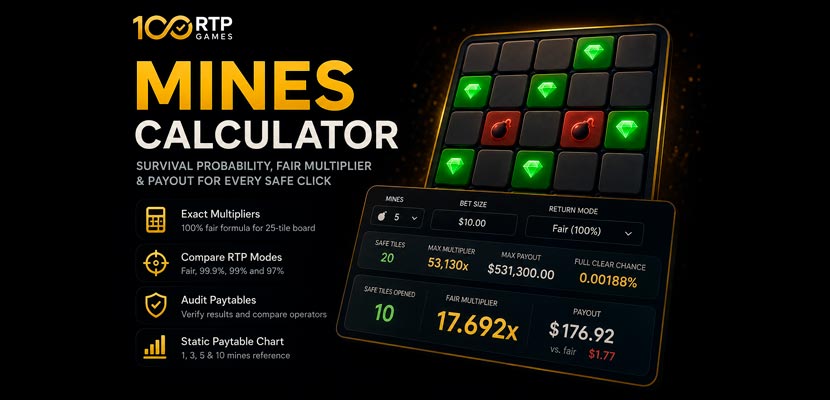
Mines cashout values are determined by cumulative survival probability. The calculator below checks one target at a time: choose the number of mines, choose how many safe tiles must be revealed, and select the RTP model you want to compare.
This page belongs to the audit layer of 100RTP.games. It is useful for answering a narrow question: does the displayed multiplier match fair math or a common reduced-return table? Hidden-board generation, platform risk and broad gameplay calculations require separate checks.
Use the Simplified Mines RTP Checker
MinesCalc.com includes bet amount, payout, profit, expected value, custom RTP, all safe-pick depths, complete multiplier tables and operator-specific versions.
Open MinesCalc.comWhat Was Intentionally Removed
| Feature | 100RTP.games Audit Checker | Full MinesCalc.com Tool |
|---|---|---|
| Mine count | 1–24 mines | 1–24 mines |
| Safe-pick target | One selected target | Selected target plus full depth table |
| RTP settings | 100%, 99.9% and 99% | Presets plus custom RTP |
| Bet amount | Not included | Included |
| Payout and profit | Not included | Included |
| Brand presets | Not included | Dedicated operator versions |
| Main purpose | RTP and paytable audit | General odds, multiplier and payout calculation |
Quick Fair-Multiplier Reference
This compact table keeps several common audit points on the page without reproducing a complete Mines chart. Values are fair 100% RTP multipliers before operator RTP, rounding, payout caps or other platform rules.
| Safe picks | 1 mine | 3 mines | 5 mines | 10 mines |
|---|---|---|---|---|
| 1 | 1.0417x | 1.1364x | 1.2500x | 1.6667x |
| 3 | 1.1364x | 1.4935x | 2.0175x | 5.0549x |
| 5 | 1.2500x | 2.0175x | 3.4269x | 17.6923x |
| 10 | 1.6667x | 5.0549x | 17.6923x | 1,088.4982x |
For every mine count and safe-pick depth, use the complete Mines multiplier chart on MinesCalc.com.
The Formula Used by the Audit Checker
For a standard 25-tile grid with M mines and a target of s safe picks, cumulative survival probability is:
P = C(25 − M, s) / C(25, s)
The fair multiplier is the inverse of that probability:
Fair multiplier = 1 / P
A reduced-return table can be approximated by applying its RTP factor:
Adjusted multiplier = Fair multiplier × RTP
For example, a fair 5.0549x multiplier becomes approximately 5.0044x at 99% RTP before operator-specific rounding.
How to Audit a Casino Mines Paytable
- Match the mine count: select the same number of mines as the live game.
- Choose one cashout depth: enter the number of safe tiles you want to test.
- Record the live multiplier: copy the value displayed by the casino.
- Compare the three modes: check whether it is closest to fair, 99.9% or 99% math.
- Allow for rounding: small differences can result from display precision.
- Repeat at another depth: consistent scaling is stronger evidence than a single matching value.
- Verify the board separately: use the Provably Fair Checker when the platform algorithm is supported.
Fair Multiplier vs Reduced-Return Table
| Mode | Multiplier Rule | Long-Run Cost per 100 Units Wagered | Audit Use |
|---|---|---|---|
| 100% RTP | Fair multiplier | 0 units | Zero-edge reference or eligible fair-pricing state |
| 99.9% RTP | Fair × 0.999 | 0.1 unit | Very low-edge or post-allowance comparison |
| 99% RTP | Fair × 0.99 | 1 unit | Common low-edge Mines estimate |
The gap shown by the checker is the difference between the fair and adjusted multipliers at the selected cashout point. It is not a prediction of what one round will return.
Allowance and Platform Context
A mathematically fair multiplier can still be conditional. Some platforms apply zero-edge pricing only while an allowance remains active, then switch to a reduced-return state. Others combine a lower visible multiplier with a separate rebate or reward layer.
| Scenario | What the Checker Can Test | What Still Needs Separate Evidence |
|---|---|---|
| Fair allowance active | Whether the visible multiplier matches 100% RTP math. | Eligibility tracker, cap and reset timing. |
| Post-cap table | Whether the visible value resembles 99.9% or 99% pricing. | The operator’s exact post-cap rule. |
| Hybrid return model | The base multiplier shown in the game. | Separate rebate, cashback or reward credit. |
| Maximum-win cap | The uncapped mathematical multiplier. | Whether the payable amount is truncated at the selected stake. |
For allowance mechanics, read Zero-Edge Allowance Explained. For the Duel implementation, use the Duel Mines audit.
What This Page Can and Cannot Prove
| Question | Answer | Reason |
|---|---|---|
| What is the fair multiplier for one selected setup? | Yes | It follows directly from cumulative survival probability. |
| Does a displayed multiplier resemble 99.9% or 99% RTP? | Yes | The selected factor can be applied to the fair value. |
| What is the payout for a specific bet? | No | Bet-size payout calculation is intentionally reserved for MinesCalc.com. |
| Were hidden mines generated correctly? | No | That requires seed data and the operator’s board algorithm. |
| Which tile will be safe next? | No | Probability math cannot reveal future hidden positions. |
| Is the casino safe or reliable? | No | Platform risk includes licensing, terms, KYC and withdrawals. |
Frequently Asked Questions
Why is this calculator simpler than before?
100RTP.games now uses this page only for RTP and paytable auditing. The complete general-purpose calculator, payout tools, custom RTP and brand presets are maintained on MinesCalc.com.
Does bet size affect the multiplier?
No. Bet size scales payout and profit, but it does not change survival probability or the theoretical multiplier. That is why this audit version does not ask for a stake.
What does the payout gap mean?
It is the difference between the fair multiplier and the selected reduced-return multiplier at one cashout target. It is a pricing comparison, not a guaranteed loss on one round.
Can the checker calculate all safe-pick depths?
It calculates one selected target at a time. The full pick-by-pick table is available on MinesCalc.com.
Can this tool prove that mine positions were fair?
No. Paytable math and hidden-board verification are separate. Board verification requires server seed, client seed, nonce and the platform’s shuffle method.
Can it predict safe tiles?
No. It only calculates the probability of reaching a selected cashout depth. It cannot identify future safe positions.
Bottom Line
This page is now a deliberately narrow Mines RTP audit checker. Use it to test one mine count, one safe-pick target and one common RTP model against exact 25-tile probability math.
Use MinesCalc.com when you need broader functionality: bet-size payouts, profit, custom RTP, complete tables, charts, odds and operator-specific calculators. Keeping those roles separate prevents duplicate tools from competing for the same search intent.