What to Verify Before Trusting Duel Beef RTP
The game mechanics are visible, but the RTP interpretation depends on whether the displayed step ladder or the Zero Edge panel controls the effective return.
Captured multipliers match a 99.2% RTP pattern under a 20-step survival model.
The UI shows a $50,000 allowance and $1,000 bet limit, but this does not prove the ladder is 0% edge.
Easy, Medium, Hard and Extreme use different step multiplier paths.
Auto mode includes steps, number of bets, on-win/on-loss and stop limits.
Completed rounds should be reproducible from the game’s fairness data.
| Provider | Duel Originals |
| Game Type | Step-based road / cashout multiplier game |
| Core Mechanic | Choose a difficulty, advance through multiplier steps and cash out before a losing step |
| Difficulty Levels | Easy, Medium, Hard and Extreme |
| Manual / Auto | Manual play and Auto mode with step count, number of bets, on-win/on-loss settings and stop limits |
| Captured Easy Ladder | 1.04x to 19.84x across 19 visible manhole steps |
| RTP Evidence from Easy Ladder | Consistent with 99.2% RTP / 0.8% edge under a 20-position survival model |
| Zero Edge UI | Panel visible in captured interface with $50,000 daily allowance, $1,000 bet limit and 0.1% post-limit wording |
| Current Classification | Road-style Duel Original with unresolved Zero Edge interpretation; displayed Easy ladder suggests 99.2% base pricing |
| Verification | Provably Fair badge visible in the game interface; completed-round reproduction still needs hands-on seed check |
Audit status: Beef should not be described as fully proven 100% RTP from the screenshot alone. The interface confirms a Zero Edge panel, but the captured Easy multiplier ladder follows a clear 99.2% pricing pattern. Until the platform documents how the Zero Edge panel applies to Beef specifically, or a completed-round audit confirms the effective pricing, this page treats the RTP as unresolved with strong evidence for 99.2% base return.
For the broader platform context, see the Duel Casino audit. For the allowance model, read zero-edge allowance explained. For outcome checks, use the Provably Fair Checker. For a related continuous cashout game, compare Duel Crash.
What Is Duel Beef?
Beef is a road-style cashout game. The player chooses a difficulty level, places a bet, then advances through a sequence of visible multiplier steps. The longer the player continues, the higher the potential payout becomes, but the probability of surviving deeper steps falls.
The interface supports both Manual and Auto play. Manual mode lets the player decide step by step. Auto mode allows preset settings such as number of steps, number of bets, on-win behavior, on-loss behavior, stop on profit and stop on loss.
This puts Beef in the broader cashout-game family, but it should not be audited as a simple continuous Crash curve. Crash has a rising multiplier and a single bust point. Beef uses a discrete step ladder where each difficulty setting has its own visible multiplier path.
Difficulty Levels and Visible Multiplier Ladders
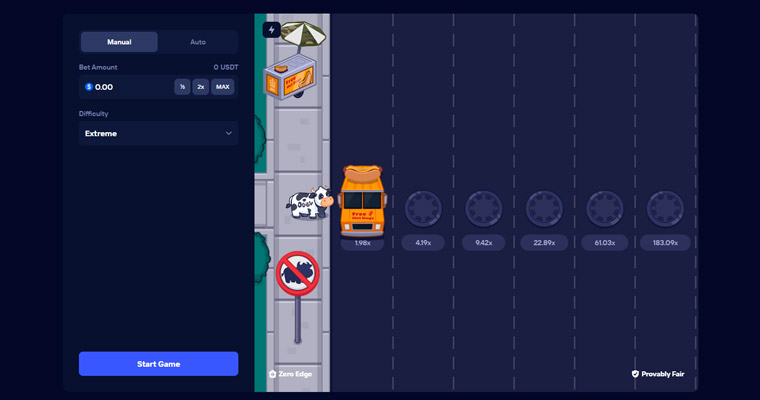
The captured interface shows four difficulty settings: Easy, Medium, Hard and Extreme. Difficulty changes the shape of the multiplier ladder. Easy produces smaller, smoother increases. Extreme produces much larger jumps and much higher variance.
| Difficulty | Visible Multiplier Ladder from Screenshot | Session Profile | Audit Note |
|---|---|---|---|
| Easy | 1.04x, 1.10x, 1.17x, 1.24x, 1.32x, 1.42x, 1.53x, 1.65x, 1.80x, 1.98x, 2.20x, 2.48x, 2.83x, 3.31x, 3.97x, 4.96x, 6.61x, 9.92x, 19.84x | Smoother progression, lower payout jumps | Captured ladder strongly indicates 99.2% RTP under a 20-position survival model |
| Medium | Not captured in the provided screenshots | Expected to sit between Easy and Hard | Needs live multiplier capture |
| Hard | Not captured in the provided screenshots | Expected to have higher step risk and larger payouts | Needs live multiplier capture |
| Extreme | 1.98x, 4.19x, 9.42x, 22.89x, 61.03x, 183.09x visible on the captured screen | Very high variance, rare deeper-step survival | Requires strict bankroll control and probability verification |
The Easy ladder is the strongest captured mathematical signal. It is not just a list of random-looking multipliers. It follows a clean relationship with a 20-position road model and a 0.992 pricing factor.
Easy Mode RTP Back-Out
The captured Easy ladder appears to use 19 advanceable steps. Under a simple 20-position survival model, the fair multiplier for step S would be:
Mfair = 20 / (20 − S)
The captured Easy multipliers are consistent with:
Mdisplayed ≈ Mfair × 0.992
That implies an effective 99.2% RTP / 0.8% edge for the displayed Easy ladder, before considering any separate return layer, promotional adjustment or UI-specific Zero Edge treatment.
| Step | Fair 0% Multiplier | 99.2% Multiplier | Captured Easy Multiplier | Match? |
|---|---|---|---|---|
| 1 | 1.0526x | 1.0442x | 1.04x | Yes, after display rounding |
| 5 | 1.3333x | 1.3227x | 1.32x | Yes |
| 10 | 2.0000x | 1.9840x | 1.98x | Yes |
| 18 | 10.0000x | 9.9200x | 9.92x | Exact display match |
| 19 | 20.0000x | 19.8400x | 19.84x | Exact display match |
RTP interpretation: This Easy ladder evidence is stronger than a generic Zero Edge label. The panel proves that a Zero Edge allowance interface is shown. The ladder proves that the captured Easy multipliers are not pure 0% edge values under the visible 20-position model. Unless another return layer compensates the difference, the displayed Easy pricing points to 99.2% RTP.
Zero Edge Panel: What It Proves and What It Does Not
The captured Beef interface shows a Zero Edge panel with a $50,000 daily limit and a $1,000 bet limit. The same panel states that after the limit is fully used, a 0.1% house edge applies to all bets until the next reset, equivalent to 99.9% RTP.
| Allowance Item | Visible Interface Value | What It Proves |
|---|---|---|
| 0% Edge Wagers | $0.00 / $50,000.00 in the captured screen | A Zero Edge allowance panel is present in the Beef interface |
| Daily Limit | $50,000.00 | The panel tracks a daily allowance window |
| Bet Limit | $1,000.00 | The panel shows a maximum eligible bet size |
| After Limit | 0.1% house edge / 99.9% RTP | The panel describes post-cap pricing after the allowance is used |
| Reset Timer | Visible countdown in the panel | The allowance refresh timing is shown to the player |
The panel does not, by itself, prove that Beef’s displayed Easy ladder is priced at 0% edge. The current evidence is mixed: the UI shows Zero Edge controls, while the Easy ladder points to 99.2% base pricing. A complete audit needs either official clarification, a live rules screenshot explaining the return layer, or completed-round verification that resolves how the ladder and the allowance panel interact.
Manual Mode vs Auto Mode
Beef supports both manual and automated play. That matters because a step-based game can become much riskier if the player lets the system continue through deeper steps without clear stop rules.
| Mode | Visible Controls | Audit / Risk Note |
|---|---|---|
| Manual | Bet amount, difficulty selection and manual start | Player decides step-by-step; execution risk depends on timing and discipline |
| Auto | Steps, number of bets, on-win behavior, on-loss behavior, stop on profit and stop on loss | Useful for discipline, but can accelerate volume through the allowance |
Auto mode does not improve expected value. It only automates the plan. If the settings are too aggressive, it can increase turnover and exhaust the allowance faster.
Beef vs Crash
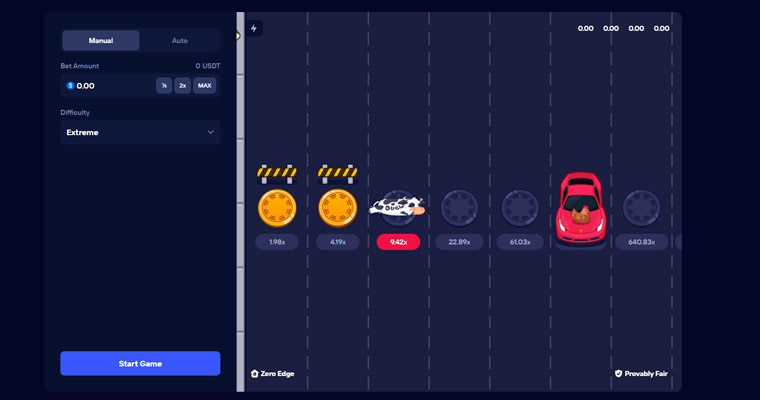
Beef and Crash both use a cashout idea, but their interfaces are different. Crash is usually a continuous rising multiplier with a single bust point. Beef uses a discrete step ladder: the player advances through visible multiplier checkpoints and chooses whether to continue or stop.
| Feature | Beef | Duel Crash |
|---|---|---|
| Core decision | Advance through steps or cash out at a visible multiplier | Cash out before the crash point |
| Multiplier structure | Discrete difficulty-based ladder | Continuous rising multiplier curve |
| Settings | Difficulty levels: Easy, Medium, Hard, Extreme | Auto-cashout target |
| Auto mode | Steps, number of bets, on-win/on-loss and stop limits visible | Auto-cashout and betting automation depending on interface |
| Audit method | Check step survival probabilities against the multiplier ladder | Check bust-point distribution against the 1/x model |
Because Beef is step-based, it should not simply inherit the Crash audit. It needs its own difficulty-specific multiplier and survival-probability check.
Beef vs Groomer’s Van
Beef and Groomer’s Van both use Duel’s themed road/cow visual language, but the mechanics are different. Beef is a step-based cashout game. Groomer’s Van is a slot-style cluster game with tumbles, free spins, multipliers and a Bonus Buy.
| Feature | Beef | Groomer’s Van |
|---|---|---|
| Game Type | Step-based road / cashout game | Cluster-pay slot-style Original |
| Main Decision | Continue or cash out at each step | Spin / buy feature; no step-by-step cashout |
| Audit Focus | Step survival probabilities and difficulty ladders | Symbol weights, tumbles, bonus frequency and multiplier symbols |
| Main Caveat | Zero Edge panel and displayed ladder create an RTP interpretation conflict | Full grid-probability model and Bonus Buy caveat |
For the slot-style audit, see Groomer’s Van.
Provably Fair Verification
A legitimate provably fair Beef round should allow the completed outcome to be checked after the relevant seed data is available. The player should be able to confirm that the step result came from committed inputs rather than being changed after the bet.
The practical verification questions are:
- Commitment: was a server seed hash shown before the round?
- Reveal: can the completed round be checked after seed rotation?
- Inputs: are client seed, nonce or round identifiers available?
- Mapping: does the seed output map clearly to the Beef step result?
- Cashout: does the verified outcome explain whether each chosen step was safe?
For general verification, use the Provably Fair Checker. For the conceptual process, read how to verify provably fair games.
What Fair RTP Does and Does Not Mean
Even if Beef were shown under a Zero Edge interface, that would not mean every session breaks even, every step is safe, or higher difficulties are better. The visible ladder shows how strongly difficulty changes variance.
- Easy difficulty: smaller jumps, smoother profile, lower variance.
- Extreme difficulty: much larger jumps, rare deeper-step survival, high variance.
- Auto mode: better execution discipline, but faster volume accumulation.
- Manual play: more control, but more exposure to emotion and timing decisions.
For the bankroll side, read can you lose with 100% RTP?. A low-edge or fair game can still create large drawdowns if the difficulty and step target are too aggressive for the bankroll.
What Still Needs Verification
| Audit Item | Status | Why It Matters |
|---|---|---|
| Zero Edge interface | Confirmed in captured Beef screenshots | Shows allowance panel, bet limit and post-cap wording |
| Easy ladder | Captured and mathematically consistent with 99.2% RTP | Strongest current pricing signal |
| Extreme ladder | Partially captured for visible steps | Useful for high-variance step audit, but incomplete |
| Medium / Hard ladders | Not captured here | Needed for full difficulty coverage |
| Return-layer interaction | Unresolved | Needed to explain how the Zero Edge panel relates to the 99.2% ladder |
| Provably fair mapping | Visible PF badge, but no completed-round seed check yet | Needed to confirm step outcomes from disclosed inputs |
Beef vs Other Duel Originals
| Game | Audit Type | Evidence Strength | Main Caveat |
|---|---|---|---|
| Dice | Direct probability / multiplier audit | Strong | Allowance state and rounding |
| Crash | 1/x cashout distribution and PF outcome checks | Strong-medium | Full bust distribution still matters |
| Mines | Combinatorial survival probability and board reconstruction | Strong | Paytable and board-generation implementation |
| Beef | Step-survival ladder and PF mapping | Medium; Easy ladder strongly suggests 99.2% base pricing | Zero Edge UI and displayed ladder need reconciliation |
| Groomer’s Van | Slot-style rules and grid probability audit | Medium | Full grid model and Bonus Buy caveat |
Frequently Asked Questions
Is Beef really 100% RTP?
The captured interface shows a Zero Edge panel, but the captured Easy multiplier ladder is consistent with 99.2% RTP under a 20-position survival model. Until Duel clarifies the interaction between the panel and the displayed ladder, the safest answer is that Beef’s effective RTP is unresolved, with strong evidence for 99.2% base pricing.
Why does the Easy ladder suggest 99.2% RTP?
Under a 20-position road model, the fair multiplier at step S is 20 / (20 − S). The captured Easy multipliers match that fair value multiplied by 0.992. That is the same as 99.2% RTP before any separate return layer.
Is Beef the same as Crash?
No. Both are cashout-style games, but Beef uses a step-based road ladder with difficulty settings, while Crash uses a continuous rising multiplier curve and bust point.
Which Beef difficulty is best?
There is no automatically best difficulty if the ladders are correctly priced. Easy is smoother. Extreme is much more volatile. The right choice depends on bankroll tolerance, not hidden profitability.
Does auto mode improve RTP?
No. Auto mode automates execution and stop rules. It does not create a mathematical edge. It can also increase wager volume quickly if settings are aggressive.
Can Beef be predicted?
No legitimate audit should assume future Beef results can be predicted. Completed outcomes can be checked after the required data is available, but future safe steps should remain unknown in a valid provably fair model.
The captured interface shows Beef beside the Zero Edge panel with a $50,000 daily limit and $1,000 bet limit. However, the displayed Easy ladder still points to 99.2% base pricing, so the exact return-layer interaction remains unresolved.
Bottom Line
Beef belongs in the Duel Originals audit cluster because it is a real Duel Original with a step-based road/cashout mechanic, difficulty levels and a visible Zero Edge panel in the captured interface. It is not a simple Crash clone, and it should not be audited with a continuous crash curve.
The most important finding is the Easy multiplier ladder. It matches a 99.2% RTP / 0.8% edge pattern under a 20-position survival model. That conflicts with a simple reading of the Zero Edge panel as proof of 0% pricing. Until that conflict is resolved through live rules, official documentation or completed-round verification, the cautious classification is: step-based Duel Original, strong evidence for 99.2% base pricing, Zero Edge UI present, effective return-layer interaction unresolved.