What to Verify Before Trusting Castle Roulette RTP
The wheel math is clean on paper, but a live multiplier game also needs payout, allowance and outcome-verification checks.
Confirm the 48-segment pattern: 24 / 12 / 6 / 3 / 2 / 1.
Check that each tier pays the inverse of its probability.
Separate native 100% pricing from 99.9% plus instant return models.
Verify whether a completed round can be reproduced from seed data.
Check whether the game is inside or outside the eligible wager window.
| Provider | Duel Originals |
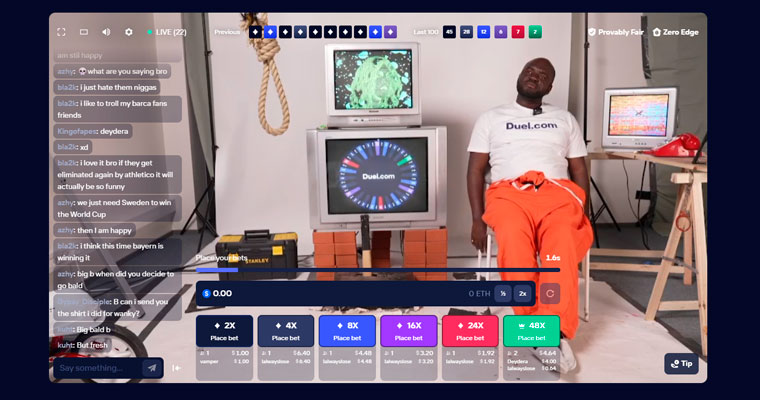
| Format | Live-hosted multiplier wheel |
| Traditional Roulette? | No; this is a multiplier wheel game, not a number-pocket roulette table |
| Wheel Segments | Reported 48 total |
| Multiplier Tiers | 2x, 4x, 8x, 16x, 24x, 48x |
| Published Segment Pattern | 24×2x, 12×4x, 6×8x, 3×16x, 2×24x, 1×48x |
| Stated Return | Promoted as 100% RTP; some reporting describes 99.9% base plus instant return |
| Allowance | Reported shared eligible wager allowance across Duel Originals |
| Betting Window | Short live-round window, reported around 12–13 seconds |
| Verification | Provably fair claimed; live seed-to-outcome check still needs hands-on confirmation |
Audit status: The published segment distribution is mathematically checkable. If the live game uses the listed segment counts and matching inverse-probability multipliers, each bet type has fair expected value before limits and rounding. We have not completed a live Castle Roulette seed-to-outcome verification, so the game-specific provably fair claim remains operator-stated for now.
Castle Roulette RTP in One Minute
| Question | Short Answer | Audit Note |
|---|---|---|
| Is this traditional roulette? | No. It is a live multiplier wheel. | Do not compare it directly with European or American roulette bet math. |
| What creates the 100% RTP case? | The reported wheel distribution matches inverse-probability payouts. | 24/48 at 2x, 12/48 at 4x, 6/48 at 8x, 3/48 at 16x, 2/48 at 24x and 1/48 at 48x all produce $1 EV per $1 if paid exactly. |
| What can reduce the effective RTP? | Allowance state, post-cap pricing, return-layer mechanics, rounding or payout changes. | The live table and tracker matter more than the headline claim. |
| Does provably fair prove the RTP? | No. It can verify outcome generation, not payout calibration by itself. | RTP requires a separate wheel distribution and payout audit. |
| Which tier is best? | None by expected value if all tiers are priced fairly. | 2x is lower variance; 48x is much higher variance. |
For the full platform context, see the Duel Casino audit. For the allowance model, read zero-edge allowance explained. For outcome verification concepts, use the Provably Fair Checker.
This Is Not Traditional Roulette
Despite the name, Castle Roulette does not use the same structure as European or American roulette. There are no numbered pockets, inside bets, outside bets, zero pockets or color/range combinations in the traditional roulette sense.
The game is closer to a live game-show wheel. Players choose one or more multiplier outcomes. A live presentation sequence runs. If the wheel lands on the selected multiplier, the bet is paid according to that tier.
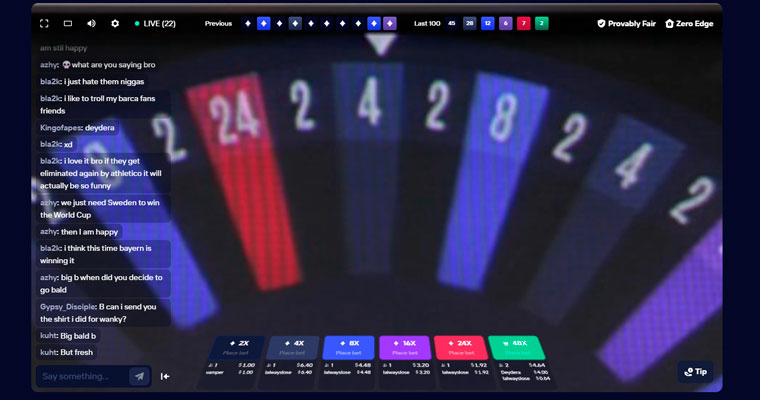
The word “roulette” refers to the spinning-wheel presentation, not to roulette mathematics. The correct audit is therefore a multiplier-wheel audit, not a traditional roulette analysis.
What Is Confirmed and What Is Still Open
| Item | Current Status | Why It Matters |
|---|---|---|
| 48-segment wheel structure | Published in promotional/game materials | Allows probability calculation if the live wheel follows the same layout. |
| Multiplier tiers | 2x, 4x, 8x, 16x, 24x and 48x are publicly described | These are the payout outcomes players bet on. |
| Published segment distribution | 24 / 12 / 6 / 3 / 2 / 1 pattern reported | This distribution creates inverse-probability pricing if the live payouts match. |
| Expected value from published table | Mathematically checkable | Each multiplier tier can be evaluated from segment count and payout. |
| Base RTP vs effective RTP | Public wording varies between 100% RTP and 99.9% base plus instant return | The player cost may be similar, but the mechanism differs. |
| Provably fair implementation | Claimed, but not independently tested here | Live wheel verification is more complex than a purely algorithmic game. |
| Physical vs digital outcome control | Not confirmed | For PF verification, the audited outcome must be reproducible from the disclosed inputs. |
Wheel Distribution, RTP and EV Math
The reported wheel layout contains six multiplier tiers. If the live game uses this distribution and pays the listed multipliers, the expected value of each tier is exactly 1.00 per $1 wagered.
| Multiplier Tier | Reported Segments | Probability | Fair Payout Check | EV per $1 |
|---|---|---|---|---|
| 2x | 24 | 24 / 48 = 50.00% | 1 / 0.5000 = 2x | $1.00 |
| 4x | 12 | 12 / 48 = 25.00% | 1 / 0.2500 = 4x | $1.00 |
| 8x | 6 | 6 / 48 = 12.50% | 1 / 0.1250 = 8x | $1.00 |
| 16x | 3 | 3 / 48 = 6.25% | 1 / 0.0625 = 16x | $1.00 |
| 24x | 2 | 2 / 48 = 4.17% | 1 / 0.0417 = 24x | $1.00 |
| 48x | 1 | 1 / 48 = 2.08% | 1 / 0.0208 = 48x | $1.00 |
This is the same basic idea as fair Dice pricing: payout equals the inverse of probability. A 2x result should occur half the time. A 48x result should occur 1 in 48 times. If both the probability and multiplier are correct, the bet has no theoretical edge before limits and conditions.
100% Formula or 99.9% Plus Instant Return?
The public descriptions around Castle Roulette are not perfectly uniform. Some materials describe it simply as 100% RTP. Other reporting describes a 99.9% base game with 0.1% returned instantly inside the eligible allowance.
Those two structures can feel similar to the player, but they are technically different:
| Model | What the Player Sees | Audit Implication |
|---|---|---|
| Native fair payout table | Multipliers equal exact inverse probabilities. | EV can be checked directly from segment count and payout. |
| 99.9% base plus instant return | Visible multipliers may be slightly reduced, with a small return layer applied separately. | Need to check both the multiplier table and the return crediting mechanism. |
| Post-allowance low-edge state | Instant return may stop or pricing may shift. | Allowance status becomes part of the RTP audit. |
The safest wording is that the published wheel math supports a fair-return model, while the exact live implementation should be checked in the game interface.
How to Audit the Live Castle Roulette Table
- Confirm the wheel pattern: check whether the live game still uses the 24 / 12 / 6 / 3 / 2 / 1 segment distribution.
- Check every payout tier: compare 2x, 4x, 8x, 16x, 24x and 48x against the inverse-probability values.
- Check allowance status: note whether the game is inside the eligible 100% RTP window or in a post-cap state.
- Look for return-layer wording: separate native fair payouts from 99.9% base plus instant return mechanics.
- Verify a completed round if possible: use the fairness panel to check whether seed data maps to the displayed multiplier.
- Repeat after the allowance resets: confirm that the same payout and tracker behavior appears in a fresh window.
This is the practical difference between a promotional RTP claim and an audit. A wheel can have mathematically fair published probabilities, but the live table still needs to match the stated layout, payout table and allowance state.
Castle Roulette vs Similar Games
| Feature | Castle Roulette | Crazy Time | European Roulette | American Roulette |
|---|---|---|---|---|
| Format | Live multiplier wheel | Live game-show wheel with bonuses | 37-pocket number wheel | 38-pocket number wheel |
| Core Bet Type | Multiplier tier | Numbers and bonus segments | Numbers, colors and ranges | Numbers, colors, ranges and extra zero pocket |
| Return Model | Promoted as fair or near-fair inside allowance | Usually mid-90s RTP depending on bet type | 97.30% RTP | 94.74% RTP |
| House Edge | Reported 0% effective or 0.1% base depending on allowance state | Material built-in edge | 2.70% | 5.26% |
| Provably Fair | Claimed by operator | Typically RNG-certified / studio controlled, not user-verifiable PF | No standard user PF | No standard user PF |
| Closest Category | Game-show multiplier wheel | Game-show multiplier wheel | Traditional roulette | Traditional roulette |
The closest comparison is Crazy Time or Dream Catcher-style game shows, not European roulette. The traditional roulette comparison is useful only to show how different the math and bet structure are.
How Verification Should Work
For a purely algorithmic game such as Dice or Mines, the verification process is relatively direct: use server seed, client seed and nonce to reproduce the result. A live-hosted wheel is harder to audit because the visual presentation and the cryptographic outcome need to align.

If the game is genuinely provably fair, the completed round should have a reproducible result in the fairness panel. The important checks are:
- Server seed commitment: the revealed seed should match the pre-round hash.
- Round input: client seed, nonce or round identifier should be available.
- Result mapping: the cryptographic output should map to the displayed multiplier tier.
- Visual alignment: the live presentation should match the verified result.
- Allowance state: the RTP state should be clear for that round.
Until a seed-to-outcome test is completed on actual Castle Roulette rounds, the PF claim should be treated as plausible but not independently verified by this page.
Who Is Castle Roulette For?
- Live game-show players: users who like presenter-led wheel games but want a lower-cost structure than typical live game shows.
- Players who want simple decisions: the choice is which multiplier tier to back, not a complex roulette betting grid.
- Variety seekers: users who want a change from Dice, Crash, Mines or Plinko without leaving the Originals ecosystem.
- Low-edge focused players: users who care about expected cost but still want a live format.
If strict auditability is the priority, simpler algorithmic Originals remain easier to verify. Dice, Crash and Mines are cleaner because there is no live presentation layer between the cryptographic result and the game outcome.
Strategy Context
If the published segment distribution and multipliers are accurate, no multiplier tier has a mathematical edge over another. Each tier has the same expected value and a different variance profile.
| Tier | Hit Frequency | Session Feel | Main Risk |
|---|---|---|---|
| 2x | Most frequent | Lower variance, frequent hits | Still vulnerable to losing streaks |
| 4x / 8x | Medium frequency | Balanced hit rate and payout | Longer dry spells |
| 16x / 24x | Low frequency | Higher volatility | Many misses before a hit |
| 48x | Rarest | Lottery-like within the game | Long droughts are normal |
Betting on multiple tiers can smooth the experience but does not create an edge by itself. It changes the distribution of wins and losses.
Related RTP and Fairness Checks
- Duel Casino audit — platform-level review of RTP claims, allowance limits and risk.
- Zero-edge allowance explained — how 100% RTP caps, trackers and post-cap rates work.
- Provably Fair Checker — seed, hash, nonce and completed-round verification.
- Duel Dice audit — cleaner formula-based RTP check using win chance and multiplier.
- Duel Crash audit — multiplier distribution and crash-point verification.
Frequently Asked Questions
Is Castle Roulette the same as traditional roulette?
No. Castle Roulette is a multiplier wheel game. It does not use numbered pockets, zero pockets, colors, inside bets or outside bets in the traditional roulette sense. The correct audit is based on segment probability and payout multiplier, not roulette house-edge tables.
Is Castle Roulette really 100% RTP?
The reported 48-segment distribution supports fair EV if the live multipliers match the inverse probabilities. Some descriptions frame the game as native 100% RTP, while others describe 99.9% base RTP plus an instant return layer inside the allowance. The safe reading is that the headline claim needs a live payout, tracker and post-cap check.
Can I verify Castle Roulette outcomes?
Duel claims provably fair verification for its Originals, but this page has not completed a live seed-to-outcome test for Castle Roulette. Treat the provably fair claim as operator-stated until you verify your own completed round with server seed, client seed, nonce or the platform’s equivalent round data.
Which multiplier is best?
If all tiers are priced fairly, none is better in expected value. The 2x tier is lower variance. The 48x tier is much higher variance. The right choice is a bankroll and volatility decision.
What happens after the allowance?
The effective return may drop to the base post-allowance state. Check the live tracker or current platform rules before assuming the same return applies to every round.
Does round history predict the next result?
No. Previous outcomes should not influence the next round in a valid independent game. Round history is useful for transparency, not prediction.
Bottom Line
Castle Roulette is best understood as a live multiplier wheel, not as roulette. The published 48-segment layout is mathematically coherent: 24 segments at 2x, 12 at 4x, 6 at 8x, 3 at 16x, 2 at 24x and 1 at 48x all produce fair EV if those are the live payouts.
The cautious classification is: mathematically sound published distribution, promoted fair-return model, and operator-stated provably fair verification pending hands-on live-round confirmation. For players who want a live game-show feel with lower theoretical cost, it is an interesting Original. For players who want the cleanest audit path, Dice, Crash and Mines remain easier to verify.