What to Verify Before Trusting Duel Dice RTP
Dice is formula-driven, so the audit is mostly about pricing, allowance status and roll verification.
Use the exact percentage shown by the slider, not a rounded mental estimate.
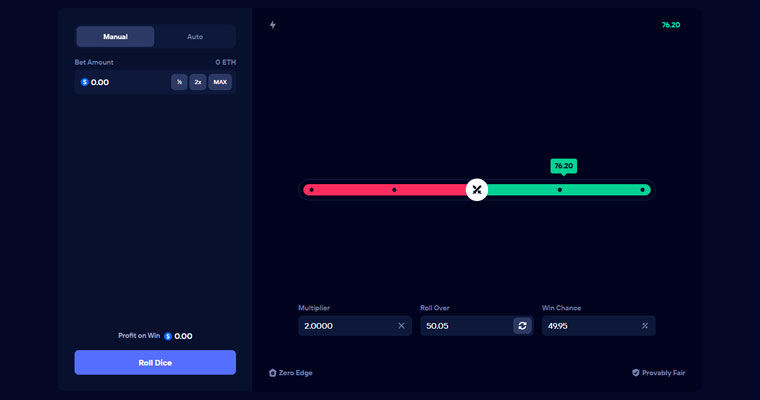
Compare displayed probability × multiplier. Our checked pair was 49.95% × 2.0000 = 99.90% base RTP.
Check whether the zero-edge window is active before calling the table fair.
Inside the allowance, Duel states that 0.1% instant rakeback offsets the 0.1% base edge; after the allowance that return stops.
Use seed data to confirm the completed roll, not to predict the next one.
| Question | Fast Answer | Audit Action |
|---|---|---|
| Is Duel Dice 100% RTP? | Effective RTP can reach 100% while the Zero Edge allowance is active, but the checked game screen itself showed 99.90% base pricing. | Check probability × multiplier, then check whether the 0.1% return layer is currently active. |
| What happens after the cap? | Duel states that the 0.1% instant rakeback stops, leaving the 0.1% base edge / 99.9% RTP. | Confirm the Zero Edge panel has moved to the post-allowance state. |
| Does provably fair prove RTP? | No. It verifies the roll generation, not the payout formula. | Run both checks: seed verification and multiplier audit. |
| Can a slider setting beat the game? | No. Slider choice changes variance, not expected value under the same return mode. | Use stake size, stop-loss and round limits instead of progression systems. |
| Provider | Duel Originals |
| Game Type | Adjustable win-chance dice game |
| Core Formula | Fair multiplier = 1 / win chance |
| Win Chance Range | Reported 1%–98%, subject to live interface checks |
| Multiplier Range | Approximately 1.02x–100x before caps or rounding |
| Stated Return | 99.90% base pricing in our checked session; effective 100% while the Zero Edge return layer is active |
| Post-Allowance | 99.9% RTP / 0.1% edge after the Zero Edge return stops |
| Allowance | $50,000 daily allowance shown in the checked Zero Edge panel |
| Max Bet | $1,000 qualifying bet limit shown in the checked Zero Edge panel |
| Verification | Seed-based outcome verification |
| Autobet | Yes, with rule-based triggers |
Audit status: Dice remains one of the clearest formula-level audits in the Duel lineup, but the live check changes the interpretation. The observed pair was 49.95% win chance at 2.0000x, so the base game returned 99.90% before the account-level Zero Edge offset. The allowance panel simultaneously showed $50,000 daily eligible volume and a $1,000 qualifying bet limit. This means the game screen and the account return layer must be audited separately.
For the broader allowance model, see zero-edge allowance explained. For roll-level outcome checks, use the provably fair checker. For a platform-level risk review, read the Duel Casino audit. For a direct cost comparison between fair and reduced-return pricing, use the edge cost calculator.
Duel Dice RTP and House Edge
Duel Dice should now be read as a two-layer pricing audit. The visible game math establishes the base RTP; the account panel determines whether the remaining base edge is being offset.
| State | Checked / Published Mechanism | Effective RTP | Expected Cost per $100 Wagered |
|---|---|---|---|
| Observed base game | 49.95% × 2.0000 = 99.90% base RTP | 99.90% before account return | $0.10 before account return |
| Inside active Zero Edge allowance | Base 0.1% edge + 0.1% instant rakeback according to Duel’s FAQ | 100.00% effective RTP | $0 expected cost under the stated model |
| After allowance | The 0.1% instant rakeback stops until reset | 99.90% effective RTP | $0.10 |
This is why Dice is useful on 100RTP.games: the base RTP can be calculated directly from the visible probability and multiplier, while the Zero Edge panel exposes the separate account-level state. The roll can be honestly generated and still have a 0.1% base edge, so payout audit, account return and provably fair verification must be treated as separate checks.
What Is Duel Dice?
Dice is a simple probability game. You choose a win chance, set the bet size, pick over or under, and the game generates a random roll. If the result lands inside your selected range, the bet pays the displayed multiplier. If it lands outside the range, the stake is lost.
The appeal is not complexity. It is auditability. Unlike blackjack, video poker or slot-style games, Dice has no strategy table, bonus feature or hidden symbol distribution to model. Once you know the win chance, the fair multiplier is immediately calculable.
That makes Dice the cleanest test case for any fair-play claim. If the visible multiplier equals the inverse of the win chance while the allowance is active, the displayed pricing matches the no-margin reference formula.
The Fair Multiplier Formula
For a generic dice game, the reference payout formula is:
Multiplier = RTP / win probability
Equivalently, RTP = win probability × gross multiplier. At true native fair pricing, RTP is 1.000. The September 24 Duel check instead showed:
49.95% × 2.0000 = 99.90% base RTP
The mathematically fair gross multiplier at exactly 49.95% probability would be about 2.0020x. The 2.0000x display therefore confirms a 0.1% base edge before the separate Zero Edge return layer.
Reference examples for exact theoretical probabilities:
- 50% win chance: 1 / 0.50 = 2.000x
- 10% win chance: 1 / 0.10 = 10.000x
- 2% win chance: 1 / 0.02 = 50.000x
- 1% win chance: 1 / 0.01 = 100.000x
These are mathematical reference values, not a claim that Duel exposes those exact slider percentages. The live audit should use the precise probability shown in the interface, including values such as the observed 49.95% rather than rounding it mentally to 50%.
Win Chance and Multiplier Table
| Win Chance | Fair Multiplier | 99.9% Version | 99% Version | Expected Cost per $100 Wagered at 99% |
|---|---|---|---|---|
| 95% | 1.053x | 1.052x | 1.042x | About $1 |
| 75% | 1.333x | 1.332x | 1.320x | About $1 |
| 50% | 2.000x | 1.998x | 1.980x | About $1 |
| 25% | 4.000x | 3.996x | 3.960x | About $1 |
| 10% | 10.000x | 9.990x | 9.900x | About $1 |
| 2% | 50.000x | 49.950x | 49.500x | About $1 |
| 1% | 100.000x | 99.900x | 99.000x | About $1 |
Extreme settings caveat: The theoretical fair multiplier at 1% is exactly 100.000x. If a live game caps the multiplier, changes the actual win chance, or applies a max-win ceiling, the effective return can differ from the clean formula. Always check the displayed value before using very low win-chance settings.
The expected cost of a 1% edge is about $1 per $100 wagered regardless of slider position. The slider changes variance, not the house edge. In short sessions, variance can be much larger than the edge difference, but over high volume the cost becomes visible.
What Provably Fair Proves
Provably fair verification can show that a specific roll was generated from committed seed data. It does not prove the RTP by itself. RTP is checked by comparing the displayed multiplier against the formula for the selected win chance.
For Dice, these two checks are separate:
- Outcome check: Can the roll be reproduced from the seed data?
- Pricing check: Does the multiplier match the selected win chance and return mode?
How the Game Works
The game generates a random result and compares it with your chosen target. Most crypto dice games use a 0–100 style result range with decimal precision, but the exact conversion method should be verified through the platform’s current fairness tool.
- Under 50: wins when the roll is below the target range; a fair 50% setup pays 2.000x.
- Under 10: wins on roughly 10% of rolls; a fair setup pays 10.000x.
- Over 95: wins on a low-probability upper-tail result; the multiplier rises accordingly.
Over and under are just two ways of selecting the winning range. They do not create an edge by themselves. The important variables are the win chance, multiplier, return mode and any limits applied by the game.
Why Dice Is Useful for Auditing
No skill component. There is no decision tree, card strategy or bonus trigger. Once the bet is placed, the result is purely random.
Direct pricing check. Multiply the displayed win probability by the displayed gross multiplier. This immediately reveals the base RTP before account-level credits.
Useful contrast. Dice showed a 99.90% base game with a separate Zero Edge return layer, while Castle Roulette settled at the full fair face multiplier in its tested allowance state. The two games therefore demonstrate why Duel Originals should be audited individually.
Clear variance control. A high win chance creates frequent small wins. A low win chance creates rare larger wins. The expected value is determined by the return factor, not by the shape of the slider.
High speed risk. Dice can be played quickly, especially with hotkeys or autobet. Fast play does not change the math, but it can make losses accumulate before the player reacts.
How to Audit the Live Duel Dice Table
- Record the exact win chance: do not round the interface value; our live test used 49.95%.
- Calculate base RTP: multiply the displayed probability by the gross multiplier. Our checked 49.95% × 2.0000 pair equals 99.90%.
- Check the Zero Edge panel: confirm whether the 0.1% return layer is active, how much allowance remains and whether the wager is within the qualifying bet limit.
- Place a small test bet: save the bet ID, client seed, nonce and visible result.
- Verify the roll: after seed reveal, reproduce the result with the provably fair checker.
- Keep the checks separate: multiplier comparison tests RTP pricing; seed verification tests outcome generation.
This workflow is deliberately narrow. It does not prove withdrawal reliability, KYC behavior or long-term platform risk. Those belong in the broader Duel Casino review.
Autobet and Betting Systems
Duel Dice includes an autobet system with rule-based actions such as changing bet size after wins or losses, setting round counts, and stopping after profit or loss thresholds.
Autobet does not create positive expected value. Martingale, reverse Martingale, loss-chasing and progression systems only reshape the distribution of results. They can create many small wins, but they also increase exposure to rare large losses when bankroll, table limits or max-bet rules are reached.
At high speed, the practical risk is behavioral rather than mathematical. A losing sequence can run through many bets before you manually intervene. If you use autobet, stop-loss and max-round limits should be treated as basic safety controls, not optional settings.
Duel Dice vs Other Dice Games
| Feature | Duel | Gamdom | Stake |
|---|---|---|---|
| Published Return Model | 99.90% base pricing observed; 0.1% instant rakeback makes eligible play effectively zero edge | $5,000 daily Zero Edge band confirmed; separate first-$50,000 Originals wording remains unresolved | 99% RTP / 1% house edge |
| Eligible Volume | $50,000 daily allowance shown in the checked account | $5,000 daily Zero Edge band in current account/KOTH wording; separate first-$50,000 documentation also exists | No fair-play allowance |
| Win Chance Range | Reported 1%–98%, verify live | Game-specific; verify live | Displayed ranges depend on game mode and multiplier settings |
| Multiplier Check | Calculate probability × multiplier, then verify the Zero Edge return state separately | Check base game pricing, $5,000 Zero Edge state and any separate reward/return layer | Correct 99% table should approximate fair multiplier × 0.99 |
| Autobet | Yes | Yes | Yes, with advanced options |
| Verification | Seed-based outcome checks | In-game verification and reward-layer checks | Provably fair outcome checks |
| Main Caveat | Allowance status and extreme-slider rounding should be checked | Hybrid return rules require more than multiplier inspection | Built-in 1% cost over volume |
For pure multiplier auditability, Dice is straightforward on any platform: check win chance, check multiplier, then calculate the return factor. The difference is that Duel and Gamdom frame part of their Originals around fair-return mechanics, while Stake clearly publishes a 99% model.
Strategy Context
There is no best win chance in a fair-pricing model. A 95% setting and a 5% setting can have the same expected value if both are priced correctly. What changes is the session profile.
- High win chance: frequent wins, small profit per win, smoother but still vulnerable to rare loss streaks.
- Medium win chance: balanced hit rate and payout size.
- Low win chance: long losing streaks, occasional larger hits, much higher emotional and bankroll variance.
The most practical strategy is not a secret slider setting. It is bankroll control: choose a bet size, define a stop-loss, set a maximum number of rolls, and avoid increasing stake size after losses unless the risk is fully understood.
Related RTP and Fairness Checks
- 100% RTP Casino Games — current game-by-game Zero Edge availability and evidence.
- Zero-edge allowance explained — how 100% RTP caps, trackers and post-cap pricing work.
- Provably Fair Checker — verify completed Dice rolls with seed and nonce data.
- Edge Cost Calculator — compare 100%, 99.9%, 99% and lower-return pricing.
- Duel Mines audit — another formula-driven Original with clear payout math.
- Duel Blackjack audit — a contrast case where player strategy affects RTP.
Frequently Asked Questions
Is Duel Dice really 100% RTP?
The checked game screen itself was not natively 100% RTP: 49.95% win probability at 2.0000x equals 99.90% base RTP. During the same check, the Zero Edge allowance was active. Duel states that a 0.1% instant rakeback offsets that 0.1% base edge on eligible wagering, producing 100% effective RTP while the allowance remains.
What is the best win chance?
There is no best setting for expected value if the game is fairly priced. High win chance lowers variance; low win chance increases it. The edge comes from the return factor, not from the slider position.
Does Martingale work at fair odds?
No. Martingale does not create profit. It converts many small wins into exposure to rare large losses when bankroll or limits are reached. A fair game removes the house drift, but it does not remove ruin risk.
How fast can Dice be played?
Dice can be played very quickly with hotkeys or autobet. Speed increases turnover and emotional risk. It also uses the daily allowance faster if the game is inside an eligible fair-play window.
What is the maximum win per bet?
The maximum payout can depend on current platform settings, bet size, multiplier caps and account limits. Check the live game panel before using very low win-chance, high-multiplier settings.
Can I predict the next roll?
No. A valid dice game should derive each result from cryptographic inputs that are fixed before the roll. Past rolls do not influence future rolls. Prediction tools and signal services should be treated as scams.
Bottom Line
Dice remains one of the cleanest mathematical tests in the Duel Originals lineup because the base return can be calculated directly from probability × multiplier. The September 24 check found 49.95% × 2.0000 = 99.90% base RTP, with the separate Zero Edge panel providing the account-level mechanism that can bring eligible wagering to 100% effective RTP.
The caution is that fair pricing does not mean safe play. Fast autobet, low win-chance settings and progression systems can still create severe drawdowns. The correct way to use Dice is to treat the multiplier as auditable, the roll as random, and the bankroll risk as fully real.