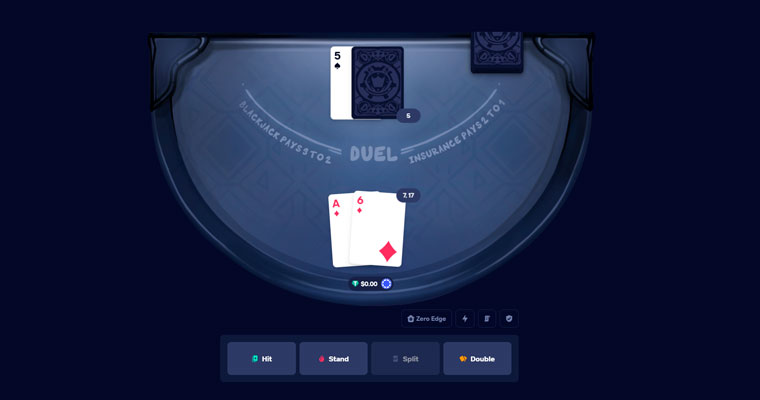
Scope: This page audits Duel Blackjack Original only. It is not a generic blackjack RTP guide. For blackjack RTP and house-edge estimates by payout, deck count, S17/H17, doubling, splits, surrender and strategy, use the Blackjack RTP Calculator.
What Must Be Verified Before Accepting Duel’s 100% RTP Claim
The official product page, economics changelog and Zero Edge FAQ establish parts of the Duel Blackjack Original model. The unresolved issue is how those parts work together during an actual hand.
| Provider | Duel Originals |
| Product Type | In-house, strategy-dependent blackjack game |
| Advertised RTP | 100% RTP |
| Official Edge Range | 0.10% to 0.57%, scaling with the base wager |
| Lowest Published Tier | 0.10% edge on base wagers up to $45,748 |
| Highest Published Tier | 0.57% edge at the maximum listed base wager of $260,608 |
| Allowance Return | The general Zero Edge FAQ documents a 0.10% allowance return |
| Splits and Doubles | Public primary documentation does not explain treatment of the added wager |
| Deck Model | Not established by the official pages reviewed |
| Verification Status | Operator-supported; not independently reproduced by 100RTP.games |
Audit status: The former 80% return theory is not supported by the current primary documentation and has been removed. It has not been replaced with a flat 0.10% model. The official evidence instead shows a variable Duel Blackjack edge, a general 0.10% allowance return and an unresolved interaction between the two.
For generic rule-specific calculations, use the Blackjack RTP Calculator. For licensing, KYC and withdrawal context, see the Duel Casino audit. The Duel Dice audit provides a useful contrast with a game whose return is easier to verify from a fixed probability formula.
Duel Blackjack Original: Current Verdict in One Minute
| Question | Cautious Answer | Evidence Status |
|---|---|---|
| Does Duel advertise Blackjack Original at 100% RTP? | Yes. | Confirmed by the official product page. |
| Is the base edge always 0.10%? | No. | The official changelog lists four wager-dependent tiers from 0.10% to 0.57%. |
| Does the general allowance return make every tier 100%? | Not established. | The public FAQ documents a 0.10% allowance credit but does not explain the higher Blackjack tiers. |
| Are split and double-down wagers compensated? | Unknown. | No primary-source rule located explains the added stake. |
| Can optimal strategy still matter? | Yes. | Player decisions change expected value independently of the allowance mechanism. |
Duel Blackjack Original Edge Tiers
Duel’s Economics Changelog replaces the idea of one universal house-edge figure with a scaling schedule. It also says the current edge is displayed on-screen while betting. The published configuration is:
| Base Wager | Published Edge | Base RTP Before Any Return |
|---|---|---|
| Up to $45,748 | 0.10% | 99.90% |
| Up to $64,044 | 0.14% | 99.86% |
| Up to $118,920 | 0.27% | 99.73% |
| Maximum base wager: $260,608 | 0.57% | 99.43% |
The thresholds are unusually high for ordinary play, so most users may only encounter the lowest tier. They still matter for audit accuracy: the operator’s own documentation shows that Duel Blackjack Original is not governed by one permanent 0.10% edge.
Why Duel’s 100% RTP Calculation Is Not Fully Documented
The general Zero Edge FAQ says eligible bets receive a 0.10% allowance return. That is enough to offset a 0.10% base edge if the entire wager qualifies. It does not, by itself, explain what happens when Duel Blackjack Original displays 0.14%, 0.27% or 0.57%.
| Displayed Edge | Base RTP | Illustrative RTP if the Return Stayed Fixed at 0.10% | Status |
|---|---|---|---|
| 0.10% | 99.90% | 100.00% | Consistent with the general FAQ if the wager is eligible. |
| 0.14% | 99.86% | 99.96% | Public documentation does not state whether compensation increases. |
| 0.27% | 99.73% | 99.83% | Cannot be called 100% without an additional mechanism. |
| 0.57% | 99.43% | 99.53% | The 100% headline requires an explanation not present in the reviewed pages. |
Do not treat the third column as Duel’s confirmed payout model. It is a diagnostic calculation showing why a fixed 0.10% return cannot mathematically neutralize every published edge tier. The live interface or a more detailed primary-source rule is required to close this gap.
Duel Blackjack Splits, Doubles and the Main Unresolved Conflict
Basic strategy sometimes requires splitting a pair or doubling the initial wager. Both actions add money after the opening bet. Public affiliate reviews disagree about whether these extra stakes receive rakeback, but the official pages reviewed do not settle the issue.
| Open Question | Why It Changes Effective RTP | Current Status |
|---|---|---|
| Does a double-down stake receive the allowance return? | Optimal play requires doubling in profitable situations, so an excluded added stake would carry uncompensated edge. | Not documented in the primary sources reviewed. |
| Does each split hand receive the same treatment? | Splitting creates an additional wager and can lead to further doubles. | Not documented. |
| Is the displayed edge calculated from the opening bet or total hand exposure? | The answer determines which percentage applies after the stake changes. | Not documented. |
| Does added exposure consume the allowance? | Allowance usage may rise faster than the opening wager suggests. | Requires a live account test. |
If added wagers are excluded, a structural tension appears: mathematically correct play increases the amount placed through splits and doubles, while part of that turnover may remain outside the return mechanism. This is a valid audit hypothesis, not a confirmed product rule.
Why Strategy Still Affects Duel Blackjack RTP
Blackjack differs from fixed-formula Originals because the player controls part of the decision tree. Duel can set payouts, rules and an allowance mechanism, but a player can still create additional expected loss by making the wrong decision.
| Play Condition | Expected Effect | Interpretation |
|---|---|---|
| Correct strategy at the lowest edge tier with full eligibility | May align with the advertised 100% effective RTP | Still requires confirmation of rules and credited wager amount. |
| Correct strategy at a higher edge tier | Depends on whether compensation scales above 0.10% | The public documentation is incomplete. |
| Strategy mistakes | Reduce actual RTP beyond the displayed base edge | The allowance cannot be assumed to refund decision errors. |
| Side bets | May carry a substantially higher house edge | Exclude them from the 100% calculation unless separately documented. |
A full basic-strategy chart is intentionally not embedded here because the correct actions depend on the confirmed payout, deck model, dealer rules, surrender timing and split restrictions. Model those settings with the generic Blackjack RTP Calculator after checking the live Duel game.
Which Duel Blackjack Rules Must Be Verified in the Game?
| Rule | Public Information | Why It Matters |
|---|---|---|
| Natural blackjack payout | 3:2 is reported externally but was not found in the crawlable official pages reviewed. | A 6:5 payout would materially reduce return. |
| Dealer soft 17 | S17 is reported by third parties; verify in-game. | H17 normally increases the house edge. |
| Double after split | Reported as available; not confirmed here from a primary rulesheet. | Changes both expected value and correct split strategy. |
| Surrender | Reported externally; timing is unresolved. | Early and late surrender have different values. |
| Deck or replacement model | Conflicting third-party claims; no reliable primary specification located. | Changes card probabilities and some strategy decisions. |
| Insurance and side bets | Not included in the verified 100% mechanism. | These wagers can carry a higher edge than the main game. |
Does Duel Blackjack Original Pay 3:2?
Several external reviews report a 3:2 natural-blackjack payout, but the public official pages reviewed for this update did not expose a complete crawlable rulesheet. Confirm the payout directly in Duel Blackjack Original before using a strategy table or RTP estimate. If the live payout is 6:5, the 100% interpretation would require a materially different compensation mechanism.
What Are the Current Duel Blackjack Rules?
The available primary pages establish the product, advertised RTP and scaling edge, not the complete ruleset. Record the blackjack payout, dealer soft-17 rule, doubling restrictions, split limits, surrender timing, dealer peek/no-peek procedure and deck model before calculating expected return.
Duel Blackjack Provably Fair: What It Can and Cannot Prove
Duel lists Blackjack among its Originals and describes its house games as provably fair. That makes outcome verification relevant, but seed reconstruction and RTP auditing remain separate tasks.
| Check | Can Establish | Cannot Establish Alone |
|---|---|---|
| Pre-game seed commitment | The operator committed to hidden input before the hand. | That table rules or allowance treatment are favorable. |
| Card-sequence reconstruction | The displayed hand follows the disclosed inputs and algorithm. | That the chosen player actions were optimal. |
| Account credit check | The user received a return after an eligible wager. | That the same treatment applies to every edge tier or added stake. |
The current status remains operator-supported but not independently reproduced by 100RTP.games. A complete test needs the pre-game commitment, revealed server seed, client seed or equivalent inputs, nonce or hand identifier, algorithm description, final card sequence and account ledger entry.
Looking for Duel Live Blackjack?
Duel also has a separate Live Casino product whose public card currently advertises 60% Instant Rakeback. It should not be confused with the in-house Duel Blackjack Original covered above.
| Feature | Duel Blackjack Original | Live Casino Product |
|---|---|---|
| Current public claim | 100% RTP | 60% Instant Rakeback |
| Main evidence needed | Edge tier, allowance credit, rules, added wagers and seed verification | Provider, table rules, standard RTP, dealer procedures and rakeback calculation |
| Provably fair assumption | Relevant to the in-house Original | Do not transfer the Original’s seed model to a live table without explicit documentation |
| Scope on this page | Full audit subject | Search-intent clarification only; not a completed live-table audit |
Users searching for Duel Live Blackjack should verify the exact live table shown in their account. The 60% headline does not by itself identify the base house edge, eligible wager definition or resulting effective RTP.
Is Duel Blackjack Legit?
Duel Blackjack Original is a real in-house game publicly listed by Duel, and the operator publishes an economics changelog, a Zero Edge FAQ and provably fair claims. That confirms the existence of the product and its stated mechanism; it does not independently prove every payout, edge tier or allowance calculation.
Platform legitimacy is broader than game mathematics. Licensing, access restrictions, KYC, withdrawals and dispute handling are covered separately in the Duel Casino review. The safest description of the game itself is documented by the operator but not yet fully independently verified.
How to Audit Duel Blackjack Original in a Live Account
- Open the correct product: use Duel Blackjack Original rather than the separate live listing.
- Record the base wager: note which official edge tier it falls into.
- Capture the displayed edge: save a screenshot before dealing.
- Check the allowance tracker: record remaining eligibility before and after the hand.
- Play a normal hand: compare the credited return with the opening wager.
- Test a double: check whether the extra stake receives a separate or proportional credit.
- Test a split: record allowance consumption and returns for both hands.
- Save fairness data: collect seeds, nonce or hand ID and the disclosed algorithm.
- Reconstruct the cards: verify that the recorded hand follows from the committed inputs.
- Repeat after the allowance: determine the actual post-limit pricing.
Evidence Hierarchy Used for the Duel Blackjack Audit
| Source | What It Supports | Weight |
|---|---|---|
| Official Duel Blackjack page | Current 100% RTP marketing claim for the Original. | Primary source |
| Official Economics Changelog | Scaling edge tiers and on-screen edge disclosure. | Primary source |
| Official Zero Edge FAQ | General 0.10% allowance-return explanation and post-allowance behavior. | Primary source |
| Official Live Casino card | Separate product and current 60% Instant Rakeback headline. | Primary source |
| Affiliate reviews | Reported 3:2, S17, DAS, surrender, deck and split/double treatment. | Secondary and conflicting; not accepted without live confirmation |
Related Duel Blackjack and Fairness Checks
- Blackjack RTP Calculator — calculate generic blackjack RTP and house edge from confirmed payout, deck and table rules.
- Zero-Edge Allowance Explained — understand eligibility, resets and post-limit pricing.
- Provably Fair Checker — test supported seed-based outcomes.
- Duel Mines RTP Audit — compare a formula-driven Original with fewer strategy variables.
Frequently Asked Questions
What is Duel Blackjack Original RTP?
Duel advertises Blackjack Original at 100% RTP. Its official changelog shows a wager-dependent edge from 0.10% to 0.57%, while the general allowance FAQ describes a 0.10% return. The exact effective RTP at higher tiers is not fully explained in the public documentation reviewed.
Is the Duel Blackjack house edge 0.10% or 0.57%?
Both figures appear in the official edge schedule. The percentage scales with the base wager: 0.10% is the lowest published tier and 0.57% is the highest listed tier.
Does the Duel allowance cover Blackjack splits and doubles?
This remains unconfirmed. The primary pages reviewed do not state whether added split or double-down stakes receive the same return, consume allowance separately or use a different edge calculation.
Is the old 80% Duel Blackjack edge-return figure still valid?
It is not supported by the current primary documentation used for this audit. Some third-party pages still repeat it, but the official pages instead describe edge tiers and a general allowance mechanism.
Does Duel Blackjack Original pay 3 to 2?
External reviews report a 3:2 natural payout, but this update did not find a complete official crawlable rulesheet confirming it. Check the current in-game rules before calculating RTP.
What are the Duel Blackjack Original rules?
The full current rules must be checked in the interface. At minimum, verify the natural payout, S17/H17, doubling, double after split, resplits, split aces, surrender, dealer peek procedure and deck model.
Is Duel Blackjack provably fair?
Duel includes Blackjack among its Originals and describes its house games as provably fair. Independent confirmation requires reconstructing a completed hand from the disclosed seed data and algorithm.
Is Duel Blackjack legit?
It is an operator-listed game with published product and economics pages. The remaining question is not whether the product exists, but whether every component of the 100% effective-return claim can be independently reproduced.
Is Duel Live Blackjack the same game?
No. The Live Casino product is listed separately and currently advertises 60% Instant Rakeback. Its provider, rules, base RTP and return calculation require a separate audit.
Can I still lose at Duel Blackjack if it is advertised at 100% RTP?
Yes. RTP is a long-run expected value, not a session guarantee. Variance, strategy errors, side bets, allowance exhaustion and unresolved added-wager treatment can all produce losses.
Bottom Line
Duel’s 100% RTP claim for Blackjack Original has primary-source support, but it is not explained by one flat 0.10% formula. The official changelog confirms a scaling edge from 0.10% to 0.57%, and the game reportedly displays the active percentage on-screen.
The decisive missing evidence is how the zero-edge allowance interacts with higher tiers, split hands and double-down stakes. Until those mechanics are tested in a live account and a completed hand is independently reconstructed, the appropriate conclusion is: Duel Blackjack Original has an operator-supported 100% RTP claim and a confirmed variable edge schedule, but the public documentation does not yet fully explain the effective-return calculation.
For blackjack RTP outside this specific Duel implementation, use the Blackjack RTP Calculator.