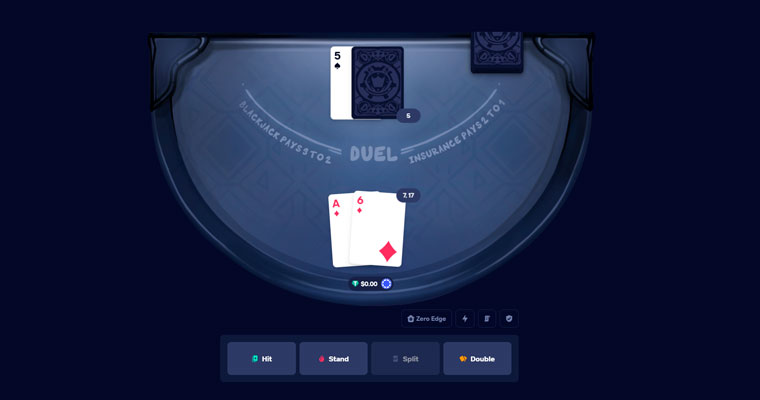
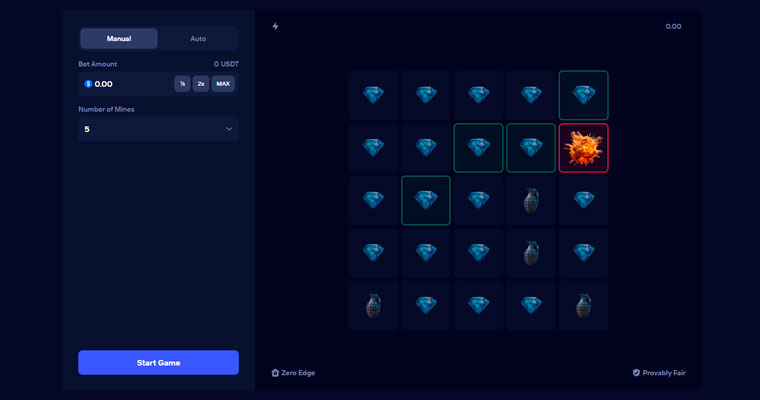
Scope: This page audits Duel Mines specifically. For generic Mines multiplier and RTP calculations, use the Mines RTP Audit Calculator.
What to Verify Before Trusting Duel Mines RTP
Mines has exact survival math, but the live table still needs allowance, multiplier and board-generation checks.
Confirm the standard 5×5 board, 25 tiles and 1–24 mine range.
Compare the displayed cashout value with C(25, s) / C(25−N, s).
Check whether the fair-play window is active or post-cap pricing applies.
Rebuild completed mine positions from server seed, client seed and nonce where supported.
Fair, 99.9%, 99% and 97% tables differ by a simple return multiplier.
| Question | Short Answer | Audit Note |
|---|---|---|
| Is Duel Mines automatically 100% RTP? | Only if the eligible allowance is active and the live multipliers match fair values. | Post-cap pricing or ineligible bet size can change the return. |
| What determines the fair multiplier? | Mine count and number of safe tiles already revealed. | The formula is C(25, s) / C(25−N, s). |
| Does cashout target change EV? | Not by itself in a fair table. | It changes variance and survival probability, not the underlying return factor. |
| Does provably fair prove RTP? | No. It can verify board generation, not payout calibration. | Multiplier audit and board audit are separate checks. |
| What should be checked live? | Allowance tracker, current multiplier, mine count, bet eligibility and completed board verification. | These are live product signals, not permanent constants. |
| Provider | Duel Originals |
| Grid | 5×5 / 25 tiles |
| Mine Count | 1–24, selected by the player |
| Safe Tiles | 24–1, depending on mine count |
| Core RTP Check | Displayed multiplier vs fair combinatorial multiplier |
| Stated Return | Fair pricing inside the eligible allowance, subject to live tracker confirmation |
| Post-Allowance | Reported as 99.9% / 0.1% edge on eligible simple Originals |
| Allowance | Shared daily wager allowance across eligible Originals |
| Max Bet | Reported $1,000 eligible bet limit |
| Verification | Provably fair seed-based board generation |
Audit status: The standard 25-tile Mines multiplier formula is mathematically exact. This page verifies the formula and gives test values for common mine counts. We have not extracted every live Duel multiplier from the game interface, so the practical check is to compare the displayed multiplier against the formula during play and then verify the board after seed rotation.
This page is a Duel Mines RTP audit, not a broad Mines strategy hub. For a focused internal calculation tool, use the Mines RTP audit calculator. For the allowance model behind eligible Originals, read zero-edge allowance explained. For round-level verification, see the provably fair verification guide.
What Is Duel Mines?
Duel Mines is a casino-original grid game. The player chooses how many mines are hidden on a 25-tile board, places a bet, then reveals tiles one by one. Each safe reveal increases the available cashout multiplier. Hitting a mine ends the round and loses the stake.
The game is useful for RTP auditing because the fair payout at every cashout point is not subjective. It follows directly from survival probability. If a live table claims fair pricing, the displayed multiplier should match the fair formula before rounding and any active cap or post-allowance adjustment.
The important distinction is that payout fairness and board fairness are separate. The multiplier formula checks whether the cashout price is fair. Provably fair verification checks whether the hidden mine layout matches committed seed data.
Duel Mines RTP and House Edge
The return mode is applied to the fair multiplier. If the game is inside a fair-play allowance, the return factor should be 1.000. If the game is in a 99.9% post-cap state, the fair multiplier is reduced by a factor of 0.999. If a table uses 99% RTP, the factor is 0.99.
| Return State | Multiplier Rule | House Edge | Audit Interpretation |
|---|---|---|---|
| Fair / 100% RTP | Fair multiplier × 1.000 | 0.00% | Expected value is neutral before rounding, caps and variance. |
| 99.9% post-cap | Fair multiplier × 0.999 | 0.10% | Small post-allowance cost, still much lower than common 99% tables. |
| 99% table | Fair multiplier × 0.990 | 1.00% | Common crypto Mines benchmark outside zero-edge allowance models. |
| 97% table | Fair multiplier × 0.970 | 3.00% | Higher-cost version; visible if the displayed multiplier is materially reduced. |
This makes the audit practical. You do not need to guess the house edge if the game shows the cashout multiplier. Choose the same mine count and reveal count, calculate the fair value, then compare it with the live number and allowance state.
How the Game Works
- Choose the mine count. The board has 25 tiles, and you choose between 1 and 24 mines.
- Place a bet. The bet amount is locked before the round starts.
- Reveal tiles. Each safe reveal increases the cashout multiplier.
- Avoid hidden mines. Hitting a mine ends the round and loses the bet.
- Cash out manually. After at least one safe reveal, you can stop and take the current multiplier.
The board should be generated before your first click. Your choices reveal a pre-set layout; they should not move the mines or alter the hidden positions after the round has started.
The Fair Multiplier Formula
After revealing s safe tiles with N mines on a 25-tile board, the fair multiplier is:
Fair multiplier = C(25, s) / C(25 − N, s)
This is the inverse of survival probability. If the chance of reaching a certain point is 20%, the fair payout is 5x. If the chance is 1%, the fair payout is 100x. A lower-return version applies a reduction factor to the fair value: for example, 99% RTP uses fair multiplier × 0.99.
For an individual click, the safe-click probability changes after every reveal:
P(click k is safe) = (25 − N − (k − 1)) / (25 − (k − 1))
That is why the multiplier does not grow linearly. Each successful reveal removes one safe tile from the remaining board, so the next click has a different probability.
Exact Multiplier Tables
These tables use the combinatorial formula above. They are not predictions or strategy recommendations; they show the fair mathematical price for reaching each reveal count on a standard 25-tile board.
3 Mines
| Safe Revealed | Survival Probability | Fair Multiplier | 99.9% Version | 99% Version |
|---|---|---|---|---|
| 1 | 88.00% | 1.136x | 1.135x | 1.125x |
| 2 | 77.00% | 1.299x | 1.297x | 1.286x |
| 3 | 66.96% | 1.494x | 1.493x | 1.479x |
| 5 | 49.57% | 2.018x | 2.016x | 1.998x |
| 10 | 19.78% | 5.055x | 5.050x | 5.004x |
| 15 | 5.22% | 19.167x | 19.148x | 18.975x |
| 20 | 0.43% | 230.000x | 229.770x | 227.700x |
| 22 max | 0.043% | 2,300.000x | 2,297.700x | 2,277.000x |
10 Mines
| Safe Revealed | Survival Probability | Fair Multiplier | 99.9% Version | 99% Version |
|---|---|---|---|---|
| 1 | 60.00% | 1.667x | 1.665x | 1.650x |
| 2 | 35.00% | 2.857x | 2.854x | 2.829x |
| 3 | 19.78% | 5.055x | 5.050x | 5.004x |
| 5 | 5.65% | 17.692x | 17.674x | 17.515x |
| 10 | 0.092% | 1,088.500x | 1,087.412x | 1,077.615x |
| 15 max | 0.0000306% | 3,268,760x | 3,265,491x | 3,236,072x |
Common table error: At 10 mines and 10 safe reveals, the fair multiplier is 1,088.50x. It is not 3,003x. The number 3,003 is C(15, 10), one part of the combinatorial calculation, not the final payout multiple.
How to Audit the Live Duel Mines Table
- Open Duel Mines and choose one mine count. Start with a simple setting such as 3 mines or 10 mines.
- Check the allowance tracker. Confirm whether the game is still inside the fair-play allowance or already in post-cap pricing.
- Reveal one safe tile and record the multiplier. Compare it with the fair formula for the same mine count and reveal count.
- Repeat at several reveal counts. Check 1, 2, 3 and 5 safe reveals rather than relying on one number.
- Account for RTP factor and rounding. A 99.9% mode should be very close to fair × 0.999.
- After the round, verify the board. Use the server seed, client seed and nonce or the platform verifier to reproduce the hidden mine positions.
- Separate payout audit from board audit. A correct multiplier does not prove the board was generated fairly; a correct board does not prove the multiplier was priced at 100% RTP.
Variance and Risk
Mine count is the volatility control. Fewer mines give safer early clicks and smaller multipliers. More mines create faster multiplier growth, but most rounds end before meaningful cashout points.
- Lower variance: 1–3 mines with early cashout after 1–3 safe reveals. The round survives more often, but payouts stay modest.
- Medium variance: 3–5 mines with 3–5 safe reveals. This range creates visible multiplier growth while keeping survival probability in a usable range.
- High variance: 8–15 mines and deeper reveal targets. The multiplier can rise quickly, but repeated busts are normal.
Changing the mine count changes distribution, not the underlying expected value in a fair-pricing model. A higher multiplier target does not make the game profitable by itself; it only changes how wins and losses are distributed.
How to Verify a Round
1. Verify the Hidden Board
After the server seed is revealed or rotated, reproduce the board-generation process using the server seed, client seed and nonce. The reconstructed mine positions should match the round you played. If the platform provides an in-game verifier, use it first, then compare with an independent verifier where possible.
2. Check the Displayed Multiplier
For any reveal count, compare the live multiplier with the formula:
C(25, s) / C(25 − N, s)
Example with 3 mines after the first safe reveal:
25 / 22 = 1.1364x
After the second safe reveal:
(25 / 22) × (24 / 21) = 1.2987x
If the platform applies a small edge after allowance exhaustion, the multiplier should be reduced proportionally. A 99.9% version would be fair multiplier × 0.999.
3. Confirm Allowance Status
Multiplier checks only make sense if you know which pricing state applies. Before using a displayed value as evidence, confirm whether the allowance is still active, whether a post-cap rate is in effect, and whether the bet size is eligible for the fair-pricing window.
Cross-Operator Comparison
| Operator | Published Return Model | Notes |
|---|---|---|
| Duel | Fair pricing inside allowance; low-edge post-allowance model reported | Tracker and multiplier checks are the main audit points. |
| Gamdom | Around 99% base RTP plus rewards and instant zero-edge returns on selected volume | Hybrid model. Do not treat it as identical to Duel without checking the live interface. |
| MetaWin | Zero House Edge version available | $25,000 max-win cap can affect large bets and high multipliers. |
| Stake | 99% RTP | 1% house edge on Stake Originals Mines. |
| Spribe / third-party Mines variants | Usually lower than Stake-style in-house versions | Different provider, different paytable, different verification path. |
Do not use one Mines formula for every operator unless the RTP, grid size, mine count range and multiplier table match. The same visual game can have materially different pricing.
What the Math Means for Strategy
There is no mine count that creates an automatic edge in a fair model. The choice is about session shape:
- Small mine count: more completed rounds, smaller swings, lower payout ceiling.
- Large mine count: more busts, larger occasional hits, heavier short-term variance.
- Early cashout: smoother distribution, but smaller upside.
- Deep reveal target: larger possible payout, but long losing sequences are expected.
The rational way to use the game is to define risk before the round: mine count, target reveals, maximum loss and cashout rule. Changing the plan mid-round usually increases volatility without improving expected value.
Related RTP and Fairness Checks
- Mines RTP audit calculator — internal tool for comparing fair and RTP-adjusted multipliers
- Zero-edge allowance explained — how fair-play caps and post-cap pricing work
- Provably Fair Checker — seed-based result verification where supported
- Duel Dice RTP audit — simpler inverse-probability pricing model
- Duel Plinko RTP audit — binomial lane odds and multiplier-table checks
Frequently Asked Questions
Is Duel Mines really 100% RTP?
It can match fair pricing while the eligible allowance is active if the displayed multiplier equals the fair combinatorial multiplier. The live allowance state, bet eligibility and post-cap rules must be checked before treating a table as 100% RTP.
What is the fair Duel Mines multiplier formula?
For a 25-tile board with N mines and s safe reveals, the fair multiplier is C(25, s) / C(25 − N, s). Lower-return modes multiply this fair value by a return factor such as 0.999 or 0.99.
Is there an optimal mine count?
Not for expected value in a fair-pricing model. Mine count changes variance, not long-term profitability. A low mine count is smoother; a high mine count is more volatile.
Can I influence where mines are placed?
No. The board should be generated before the round starts. Your clicks reveal hidden positions; they should not change the mine layout.
Why do losing streaks happen if the game is fairly priced?
Fair pricing does not prevent variance. With 10 mines, revealing 5 safe tiles has only about a 5.65% survival probability. That means most attempts at that target will fail even when the multiplier is mathematically fair.
Does provably fair verification prove the RTP?
No. Provably fair verification can confirm the hidden board for a completed round. RTP requires checking the displayed multiplier against the fair formula and the active return state.
Does the allowance make every bet fair?
Only eligible bets inside the active allowance should be treated that way. If the allowance is exhausted, if a bet exceeds the eligible limit, or if the game uses a different return model, the displayed multiplier may reflect a lower return.
Bottom Line
Mines is one of the easiest casino Originals to audit mathematically because each cashout point has a precise survival probability. On a 25-tile board, the fair multiplier after s safe reveals with N mines is C(25, s) / C(25−N, s). That formula lets you check whether a displayed paytable is fair, reduced by a known edge, or inconsistent with the stated model.
For Duel specifically, the important checks are the allowance state, the displayed multiplier and the provably fair board reconstruction. The formula confirms what the multiplier should be. The live interface confirms which pricing state is being applied. The seed process confirms whether the hidden board was generated as claimed.