What to Check Before Trusting a Zero-Edge Claim
The headline matters less than the game-level pricing, account state, limits and evidence available to the player.
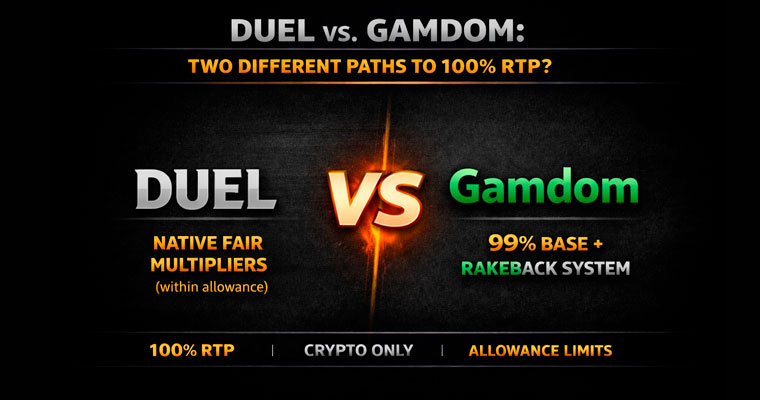
Duel vs Gamdom vs MetaWin: Quick Comparison
| Platform | Current Classification | Checked / Published Mechanism | Main Constraint | Evidence Reading |
|---|---|---|---|---|
| Duel | Allowance-based, game-specific Zero Edge | Dice showed 99.90% base pricing inside the Zero Edge state; Castle Roulette used the full fair face paytable in the tested allowance state. | $50,000 daily allowance and $1,000 qualifying bet limit were visible during the September 24 check. | Strongest on audited simple games |
| Gamdom | Confirmed $5K zero-edge band; wider structure unresolved | The checked account panel showed a $5,000 daily Zero Edge allowance. Gamdom also states that the first $5,000 across in-house games runs at effective 100% RTP via 1% Instant Rakeback. | A separate Originals article still describes around 99% base RTP, rewards and instant returns across the first $50,000 wagered. | Live $5K state; conflicting wider wording |
| MetaWin | Live product / catalogue mismatch | No ZERO title was found in the checked casino lobby or by searching “zero”, while parts of MetaWin’s public catalogue still list ZERO titles at 100% RTP. | Availability is not synchronized across the live casino and public documentation; older Zero House Edge terms also retain a maximum-win rule. | Re-audit before treating as active |
For current title-level availability rather than platform-model comparison, see our game-by-game 100% RTP availability audit. For a reproduced end-to-end example, see the Castle Roulette verification.
Most important distinction: the same casino can use more than one Zero Edge implementation. A badge, a fair paytable, an instant return and a provably fair outcome are separate claims and should be verified separately.
Evidence Quality by Claim
| Claim | Primary Evidence Available | Current Audit Position |
|---|---|---|
| Duel provides zero-edge play on eligible Originals | Zero Edge panel, game interfaces, FAQ, fairness documentation, economics changelog and first-party payout checks. | Supported, but the implementation is game-specific rather than one universal formula. |
| Duel uses one identical edge model for every Original | No. Dice and Castle Roulette already show different settlement structures, and Blackjack has separate published edge tiers. | Do not generalize one Duel Original’s mechanism to all other games. |
| Gamdom has a confirmed zero-edge band | The checked account panel showed a $5,000 daily allowance; Gamdom’s King of the Hill Help Center separately describes the first $5,000 of in-house wagering as effective 100% RTP through 1% Instant Rakeback. | The $5,000 state is supported. Do not automatically extend the same percentage or mechanism to the separate $50,000 wording. |
| Gamdom Originals are universally native 100% RTP | No. Gamdom’s Originals Help Center describes around 99% RTP, rewards and an instant-return component on certain games. | Keep the game layer and account-return layer separate. |
| MetaWin currently offers an easily discoverable ZERO range in the casino UI | Our September 24 lobby check found regular Originals only and a search for “zero” returned no games. MetaWin’s public catalogue still contains ZERO-labelled titles. | Treat this as a product/documentation mismatch until the live casino and catalogue agree. |
How the Models Differ
| Model | How It Can Reach a Zero-Edge Headline | Best Audit Method | Main Failure Point |
|---|---|---|---|
| Fair face payout inside allowance | The displayed payout matches the inverse probability while the eligible account state remains active. | Audit the probability distribution, settlement amount and active allowance separately. | Assuming the same pricing remains after the allowance or applies to every game. |
| Base edge plus instant return | A game below 100% base RTP combines with an automatic account-level return during eligible wagering. | Measure the base settlement and the actual return credit independently. | Calling effective 100% RTP “native 100% RTP” when the base game still has an edge. |
| Max-win capped fair game | The uncapped probability and payout model can be fair until a payout ceiling truncates some outcomes. | Calculate stake × multiplier and compare it with the applicable maximum win. | Payout truncation lowers effective RTP for affected configurations. |
| Ordinary rakeback or rewards | Part of an existing house edge is returned after play. | Calculate the actual percentage, eligible products and credit basis. | The rebate may be smaller than the game edge or conditional on VIP status. |
Duel: One Allowance, More Than One Game-Level Implementation
Duel Casino Allowance Model
Duel’s current evidence shows why “Zero Edge” should not be reduced to one formula. Dice displayed a 49.95% win chance at 2.0000x, which is 99.90% base RTP, while the simultaneous account panel showed the Zero Edge state. Castle Roulette behaved differently: its counted 48-position wheel used fair face multipliers, and a $10 bet on 2x settled at the full $20.00 while the allowance was active.
The platform also publishes game-specific exceptions. Blackjack has separate base-edge tiers from 0.10% to 0.57%, and the exact interaction between those tiers, additional split/double wagers and the account-level Zero Edge state is not fully documented.
The Castle Roulette audit is currently the strongest full-chain example on the site because the wheel distribution, face payout and one completed provably fair round were all reproduced independently.
Gamdom: $5,000 Live Zero Edge Band, Wider Documentation Still Conflicts
Gamdom Hybrid / Allowance Model
Gamdom’s strongest current evidence is the $5,000 state. The checked account panel showed a $5,000 daily Zero Edge allowance and stated that a 1% house edge / 99% RTP applies after the allowance. Gamdom’s King of the Hill Help Center independently describes the first $5,000 wagered across in-house games as running at effective 100% RTP, with 1% value returned through Instant Rakeback.
A separate Gamdom Originals Help Center article uses different wording. It describes around 99% base RTP, rewards and a small instant-return component on certain games for the first $50,000 wagered. Those statements should not be merged into a single assumed $50,000 zero-edge allowance because the operator does not establish the same percentage or reset structure across both passages.
This is why Gamdom needs both game-level and account-level checking. A visible 99% base game plus a 1% automatic return can produce 100% effective RTP inside a defined state without making the underlying game natively fair.
MetaWin: Live Lobby and Public Catalogue Are Out of Sync
Which Audit Path Fits Which Question?
| Question | Best Starting Point | What to Verify |
|---|---|---|
| Does the game itself settle at a fair face payout? | Duel Castle Roulette | Probability distribution, face multiplier, settlement and allowance state. |
| Can an account-level return turn a 99% game into effective 100% RTP? | Gamdom’s confirmed $5,000 band | Base RTP, Instant Rakeback percentage, eligible volume and post-limit state. |
| Is a documented zero-edge product actually available now? | MetaWin live UI vs public catalogue | Casino search, game launch availability, current RTP and current maximum-win terms. |
These classifications describe product mechanics and evidence status. Licensing, jurisdiction, KYC, withdrawal terms and account risk remain separate checks.
What Does Not Count as Zero Edge?
- 99% RTP alone: a 1% edge is low, but it is not zero.
- Unspecified “up to” rewards: theoretical maximum rewards are not guaranteed effective RTP.
- Lossback: it normally depends on losing over a period and does not offset every wager.
- Token rewards: value depends on liquidity, price and withdrawal conditions.
- Deposit bonuses: wagering requirements and maximum-cashout rules can dominate the headline value.
- Provably fair alone: an honest outcome can still use an edge-bearing payout table.
For the full distinction, read Zero Edge vs Rakeback.
How to Audit a Zero-Edge Crypto Casino
- Identify the exact product: do not infer game availability from an old marketing page.
- Identify the mechanism: fair multiplier, allowance, instant credit, rewards or payout cap.
- Record the active state: allowance balance, qualifying bet limit, reset timing and post-limit pricing.
- Audit the game layer: compare multipliers or paytables with the probability model.
- Audit the account layer: verify any rakeback or instant-return credit separately from base settlement.
- Verify the outcome separately: use the Provably Fair Checker where the algorithm is supported.
- Recheck availability: if the public catalogue and casino UI disagree, treat the offer as unresolved.
- Check platform risk: license, restricted territories, KYC and withdrawal terms remain separate from RTP.
Related RTP and Fairness Checks
- Game-by-game 100% RTP availability
- Castle Roulette verification
- Casino Reviews and Platform Audits
- Zero-Edge Allowance Explained
- Zero Edge vs Rakeback
- Duel vs Gamdom
- Edge Cost Calculator
- Provably Fair Checker
Frequently Asked Questions
Does Duel use one Zero Edge formula for every Original?
No. Dice showed 99.90% base pricing inside the account-level Zero Edge state, while Castle Roulette settled at its full fair face multiplier in the tested allowance state. Blackjack also has separate published base-edge tiers.
What is the confirmed Gamdom Zero Edge limit?
Our checked account panel showed a $5,000 daily allowance. Gamdom’s King of the Hill Help Center also says the first $5,000 wagered across in-house games runs at effective 100% RTP through 1% Instant Rakeback.
What does Gamdom’s separate $50,000 wording mean?
A different Originals Help Center article describes around 99% base RTP, rewards and instant returns on certain games across the first $50,000 wagered. It does not establish that the same 1% full offset continues throughout that entire amount, so the two descriptions should not be merged.
Are MetaWin ZERO games currently active?
The answer is unresolved. No ZERO-labelled title was found in our September 24 casino check and a search for “zero” returned no results, while MetaWin’s public catalogue still lists ZERO-labelled games. We therefore do not treat the catalogue alone as proof of current live availability.
Is provably fair the same as zero edge?
No. Provably fair checks outcome generation. Zero edge depends on payout pricing, account credits, allowances and any payout caps.
Can a player lose at 100% RTP?
Yes. Zero edge removes long-run mathematical margin under the stated conditions; it does not remove variance, losing streaks or bankroll risk.
Bottom Line
The September 2026 evidence no longer supports treating Duel, Gamdom and MetaWin as three interchangeable versions of the same product. Duel has a visible $50,000 allowance but different game-level implementations. Gamdom has a confirmed $5,000 effective-100% band alongside separate first-$50,000 documentation that should not be merged into the same rule. MetaWin’s live casino and public catalogue currently disagree about ZERO game availability.
The useful comparison is therefore the exact game, its base pricing, the active account state, the applicable limit and the evidence available on the check date. For the current title-level view, use the 100% RTP Casino Games audit.