What to Verify Before Trusting Duel Video Poker RTP
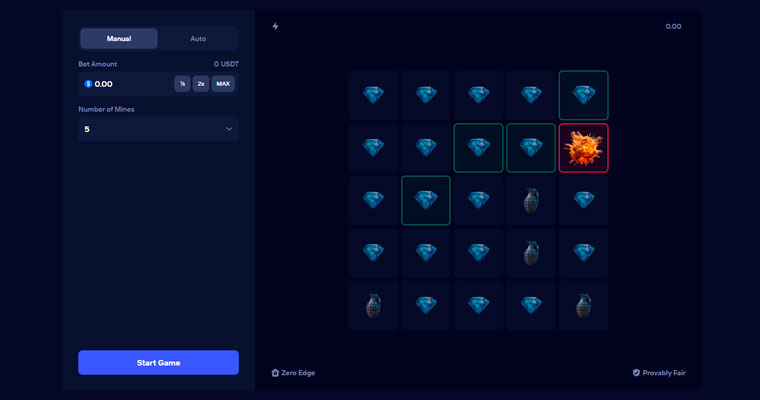
Video poker is not a fixed-return game like Dice or Mines. The paytable and player strategy determine the real return.
Record every payout, especially Royal Flush, Full House and Flush.
Confirm it is Jacks or Better, not another poker variant with different returns.
100% RTP, if available, requires correct paytable-specific decisions.
Check whether the initial hand and replacement cards can be verified from seed data.
Verify whether the same fair-play allowance or post-limit logic applies.
| Question | Short Answer | Audit Note |
|---|---|---|
| Is Duel Video Poker automatically 100% RTP? | No. The paytable and strategy assumptions must be verified. | Jacks or Better as a name is not enough to confirm the return. |
| What is the benchmark? | Full-pay 9/6 Jacks or Better is about 99.54% with optimal strategy. | A true 100% version needs enhanced payouts or a separate return layer. |
| Does strategy affect RTP? | Yes. Hold/discard decisions materially change effective return. | A poor strategy can erase any theoretical advantage. |
| Does provably fair prove the RTP? | No. It can verify card generation, not the paytable return. | Deck fairness and paytable fairness are separate checks. |
| What is still unresolved? | Exact live paytable, deck shuffle model, replacement-card process and allowance treatment. | These need live interface confirmation before a firm RTP rating. |
| Provider | Duel Originals |
| Reported Variant | Jacks or Better |
| Deck | Reported standard 52-card deck |
| Stated Return | Operator-stated fair-return claim; live paytable audit pending |
| Standard Benchmark | 9/6 Jacks or Better returns about 99.54% with optimal strategy |
| Strategy Dependence | High; incorrect holds reduce effective return |
| Allowance | Not separately confirmed for this game; verify live tracker/rules |
| Verification | Provably fair card/deck verification reported; exact shuffle model not independently checked |
Audit status: The key missing item is the exact live paytable. In video poker, the variant name is not enough. Jacks or Better can return 99.54%, 98.39%, 97.30%, 96.15% or another figure depending on the Full House, Flush, Royal Flush and other payouts. Until the live payout schedule is documented, the 100% RTP claim should be treated as operator-stated.
For related strategy-dependent analysis, see the Duel Blackjack RTP audit. For the full platform context, read the Duel Casino review. For outcome verification, use the Provably Fair Checker.
What Is Duel Video Poker?
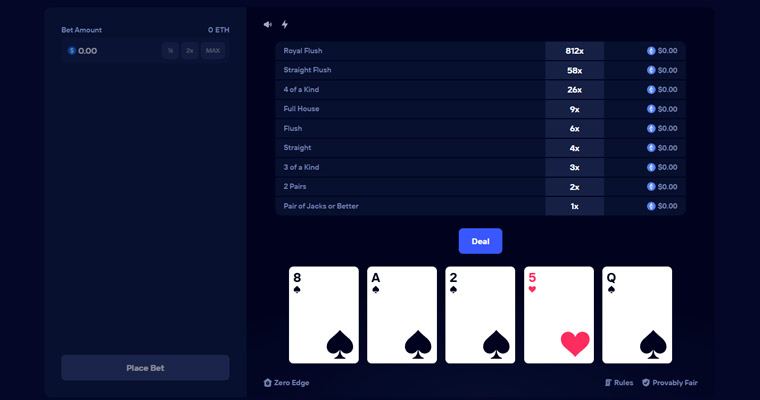
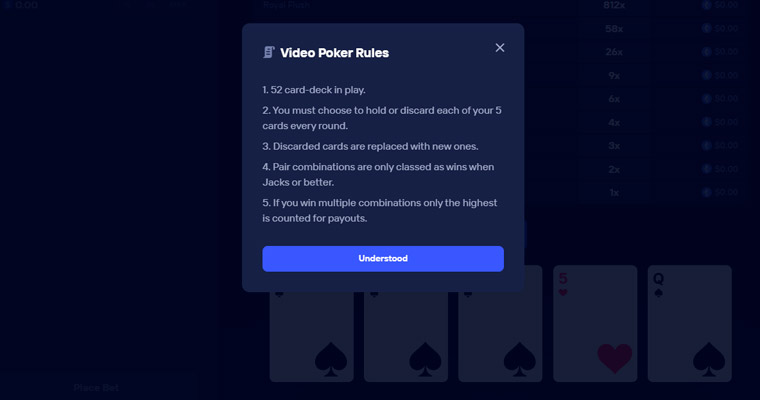
Video poker is a draw poker game played against a paytable, not against other players. You receive five cards, choose which cards to hold, discard the rest, and draw replacements. The final five-card hand determines the payout.
Duel describes its version as Jacks or Better, the most studied video poker variant. In Jacks or Better, the lowest paying hand is a pair of Jacks, Queens, Kings or Aces. Stronger hands such as Two Pair, Three of a Kind, Straight, Flush, Full House, Four of a Kind, Straight Flush and Royal Flush pay higher multipliers.
The important point is narrow but important: video poker RTP is not fixed by the name “Jacks or Better.” It is determined by the paytable, the deck process and the player’s hold/discard decisions.
Duel Video Poker RTP and House Edge
The cautious reading is that Duel Video Poker may be part of the platform’s fair-return positioning, but the RTP cannot be confirmed until the live paytable is known. Unlike Dice or Mines, there is no one-line inverse-probability formula that proves the whole return from a visible slider.
| RTP Layer | What It Means | Current Confidence | What Must Be Verified |
|---|---|---|---|
| Variant | Jacks or Better-style rules define the hand ranking and minimum paying hand. | Medium | Confirm the live rules panel. |
| Paytable | Every payout affects theoretical return and optimal strategy. | Low until extracted | Record all payouts, not only Full House and Flush. |
| Strategy | Theoretical RTP assumes correct holds and discards. | High as a principle | Use a strategy chart for the exact paytable. |
| Allowance / return layer | A separate mechanism may close the gap from standard 9/6 toward fair return. | Low until confirmed live | Check tracker, crediting rules and post-cap behavior. |
| Deck verification | Initial hand and replacement cards should be reproducible from committed randomness. | Operator-stated | Verify completed hands through the fairness flow where available. |
If the table is standard 9/6 Jacks or Better and there is no return layer, the native mathematical return is below 100%. If the table is enhanced or the game uses a separate allowance-based return layer, the full model must be recalculated from live rules.
What Is Confirmed and What Is Still Open
| Item | Current Status | Why It Matters |
|---|---|---|
| Variant | Reported as Jacks or Better | Defines the hand rankings and minimum paying hand. |
| Deck | Reported as 52 cards | Deck composition affects shuffle verification and hand probabilities. |
| Paytable | Not independently extracted here | This is the central RTP variable. |
| 100% RTP claim | Operator-stated | Cannot be confirmed without paytable analysis or a documented return layer. |
| Strategy model | Pending live paytable | Optimal strategy changes when payouts change. |
| Provably fair deck process | Reported but not independently reconstructed on this page | Needed to confirm that the deal and draw cards match committed randomness. |
| Allowance treatment | Not separately confirmed | Determines whether fair-return pricing depends on the same eligible wager window as other Originals. |
Why the Paytable Is the Key Question
Jacks or Better paytables are usually named by their Full House and Flush payouts. A “9/6” table pays 9 for a Full House and 6 for a Flush. A “8/5” table pays 8 for a Full House and 5 for a Flush.
Those small differences change the theoretical return substantially.
| Paytable | Full House | Flush | Approx. RTP with Optimal Strategy |
|---|---|---|---|
| 9/6 Jacks or Better | 9 | 6 | 99.54% |
| 8/6 Jacks or Better | 8 | 6 | 98.39% |
| 8/5 Jacks or Better | 8 | 5 | 97.30% |
| 7/5 Jacks or Better | 7 | 5 | 96.15% |
| Custom enhanced table | 9 or higher | 6 or higher | Could approach or reach 100%, depending on all payouts |
Even full-pay 9/6 Jacks or Better is below 100%. A true fair-return version would need an enhanced paytable, a return layer, or some other mechanism that closes the remaining gap.
What a 100% Paytable Would Need
There is more than one way to engineer a higher-return Jacks or Better table. The operator could increase the Royal Flush payout, increase Full House or Flush payouts, adjust several hand types, or use a separate reward layer.
The cleanest check is not to guess the method. Open the game and inspect the live paytable.
| Hand | Standard 9/6 JoB Payout | What to Check in Duel |
|---|---|---|
| Royal Flush | 800-for-1 on max-coin style paytables | Is it higher than the 9/6 benchmark, or handled by a special payout? |
| Straight Flush | 50 | Is it standard or enhanced? |
| Four of a Kind | 25 | Is it standard or enhanced? |
| Full House | 9 | Is it 9 or higher? |
| Flush | 6 | Is it 6 or higher? |
| Straight | 4 | Is it standard or enhanced? |
| Three of a Kind | 3 | Usually standard, but verify. |
| Two Pair | 2 | Usually standard, but verify. |
| Jacks or Better | 1 | Usually standard, but verify. |
Royal Flush caveat: Raising the Royal Flush payout is one possible way to close the gap from 99.54% toward 100%. A rough estimate puts the needed Royal payout near the high-900s if the rest of the 9/6 table stays similar, but the exact figure depends on strategy re-optimization and the full paytable.
Strategy Dependence
Video poker is not a fixed-return game for every play style. The published RTP assumes optimal decisions. If you hold the wrong cards, break the wrong hands, chase weak draws or ignore the paytable, the effective return falls.
| Game Type | Does Strategy Affect RTP? | What Changes the Return? |
|---|---|---|
| Dice | No | Win chance changes variance, not expected value if priced correctly. |
| Mines | No | Cashout target changes survival profile and variance. |
| Plinko | No | Risk level changes distribution, not return if table is calibrated. |
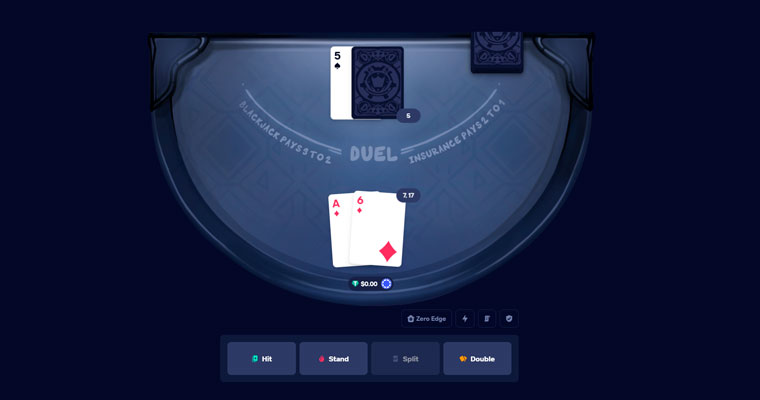
| Blackjack | Yes | Hit, stand, double, split and surrender decisions affect EV. |
| Video Poker | Yes | Hold/discard decisions and paytable-specific strategy affect EV. |
A strategy chart is not optional if the goal is to approach theoretical return. The correct chart depends on the actual paytable. A table with an enhanced Royal Flush may change the value of Royal draws compared with standard 9/6 Jacks or Better.
How to Audit the Live Duel Video Poker Paytable
- Confirm the variant. Verify that the live game is Jacks or Better and not Bonus Poker, Double Bonus or another paytable family.
- Record every payout. Include Royal Flush, Straight Flush, Four of a Kind, Full House, Flush, Straight, Three of a Kind, Two Pair and Jacks or Better.
- Check max-coin or bet-size effects. Video poker tables sometimes change Royal Flush value by stake unit or coin count.
- Run a custom paytable calculation. Use a video poker analyzer that supports the exact payout schedule.
- Generate the correct strategy. A modified paytable needs a modified hold/discard chart.
- Check allowance or return-layer rules. If the fair return is credited separately, the paytable alone may not show the full model.
- Verify completed hands where possible. Confirm that the initial deal and draw cards can be reproduced from committed seed data.
This audit separates three things that are often conflated: the paytable return, the player’s strategy quality and the randomness verification. A page can verify one of these without proving the other two.
How to Verify Duel Video Poker
1. Inspect the Paytable
Before playing for meaningful stakes, open the game rules or paytable. Write down every payout: Royal Flush, Straight Flush, Four of a Kind, Full House, Flush, Straight, Three of a Kind, Two Pair and Jacks or Better.
If the table is exactly standard 9/6 Jacks or Better, the return is not 100% by native paytable math. If any payout is enhanced, calculate the new theoretical return using a video poker analyzer that supports custom paytables.
2. Check the Strategy Assumption
Once the paytable is known, use a strategy chart for that exact table. Do not assume that a generic Jacks or Better chart is optimal if the Royal Flush or other payouts are modified.
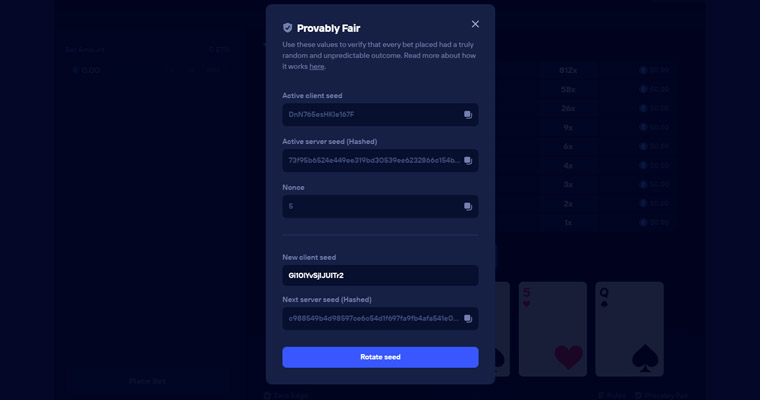
3. Verify the Deck Shuffle
A provably fair video poker implementation should allow the full card sequence to be reproduced from committed inputs. In a typical model, the full deck is shuffled before the decision point. The first five cards form the initial hand, and later cards form the replacement queue.
The important audit question is whether discarded cards are replaced from a pre-determined deck order, not generated adaptively after the player chooses holds. A valid implementation should not be able to change replacement cards based on the player’s decision.
4. Confirm Allowance and Post-Limit Rules
Some Duel Originals use an eligible wager allowance. Video Poker should not be assumed to follow the same exact treatment until the live game rules or tracker confirm it. Check whether the stated return applies before and after any allowance limit.
Paytable Audit Checklist
- Confirm variant: Jacks or Better, not Bonus Poker, Double Bonus or another variant.
- Confirm deck: standard 52-card deck, no wild cards.
- Record all payouts: do not check only Full House and Flush.
- Check Royal Flush treatment: max-coin bonus, fixed multiplier or custom payout.
- Use a custom video poker calculator: calculate theoretical return from the exact table.
- Use paytable-specific strategy: modified payouts can change optimal holds.
- Verify shuffle after seed reveal: reproduce initial hand and draw sequence where possible.
- Check allowance state: confirm whether RTP changes after eligible volume is used.
Variance Profile
Video poker often feels smoother than high-risk Plinko, Keno or deep Mines targets, but it still has meaningful variance. A large part of the long-term return in Jacks or Better comes from rare premium hands, especially the Royal Flush.
| Hand Type | Role in Variance | Practical Meaning |
|---|---|---|
| Jacks or Better / Two Pair | Frequent small returns | Smooths the game but does not create major profit. |
| Three of a Kind / Straight / Flush | Medium-frequency value | Important for session stability. |
| Full House / Four of a Kind | Lower-frequency boosts | Can swing a session significantly. |
| Royal Flush | Rare high-value event | A large part of top-end return may be concentrated here. |
If a 100% table relies heavily on a higher Royal Flush payout, the game may be fair on paper but more volatile in practice. Many sessions will not include a Royal, so short-term return can sit below the theoretical number for long stretches.
Related RTP and Fairness Checks
- Duel Blackjack RTP audit — another strategy-dependent Duel Original
- Duel Casino review — platform-level allowance, KYC, withdrawal and license risk
- Zero-edge allowance explained — how fair-play windows and post-cap pricing work
- Provably Fair Checker — seed-based result verification where supported
- Duel Dice RTP audit — simpler fixed-formula comparison
Frequently Asked Questions
Is Duel Video Poker really 100% RTP?
The claim should be treated as unconfirmed until the live paytable and any return-layer rules are documented. Standard 9/6 Jacks or Better returns about 99.54% with optimal strategy, so a true 100% model requires enhanced payouts or another mechanism.
Is Duel Video Poker confirmed as Jacks or Better?
It is reported as Jacks or Better with a 52-card deck, but this page has not independently verified the live game interface. Check the rules panel before playing.
What exact paytable makes Jacks or Better 100% RTP?
There is no single universal answer. Raising the Royal Flush payout is one possible route, but the exact return depends on all payouts and the optimal strategy after changes. The live paytable must be analyzed directly.
Does strategy affect the RTP?
Yes. Video poker is strategy-dependent. The theoretical return assumes correct holds and discards. A player using poor strategy will receive a lower effective return.
How does it compare with Blackjack?
Both are strategy-dependent Duel Originals. Blackjack return depends on rules and decisions. Video Poker return depends on paytable and hold strategy. Neither should be treated like Dice, where the formula is visible immediately.
How are replacement cards determined in a provably fair implementation?
A valid implementation should determine the deck order from committed seed data before the draw decision. Replacement cards should come from that pre-determined order, not be generated after seeing which cards the player holds.
Does provably fair verification prove the Video Poker RTP?
No. It can verify that a deal and draw sequence matches committed randomness. It does not prove that the paytable is priced at 100% RTP or that the player used optimal strategy.
Bottom Line
Duel Video Poker is an interesting Original because Jacks or Better is a solved, strategy-dependent game with well-known paytable benchmarks. That also makes the audit standard clear: the paytable must be inspected.
The cautious classification is: reported Jacks or Better Original, reported 52-card deck, operator-stated fair-return claim, and independent RTP verification pending live paytable extraction. If the live table is only standard 9/6, the native return is about 99.54%, not 100%. If the table is enhanced or the return is supplemented by a separate layer, it must be recalculated with paytable-specific strategy.