MetaWin Review in One Minute
| Question | Current Assessment | Evidence Boundary |
|---|---|---|
| Who currently operates MetaWin? | Rivolo Limited, Nevis company number C62588. | Based on the current official MetaWin footer. |
| What licence is currently published? | Anjouan licence ALSI-202602025-FI1. | Offshore licensing does not provide UKGC- or MGA-level recourse. |
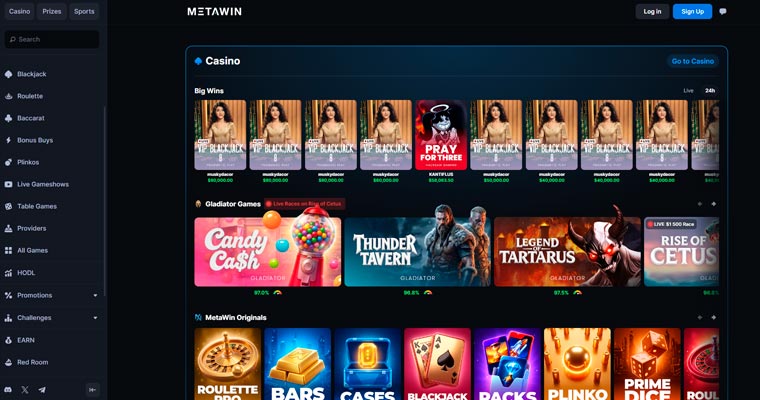
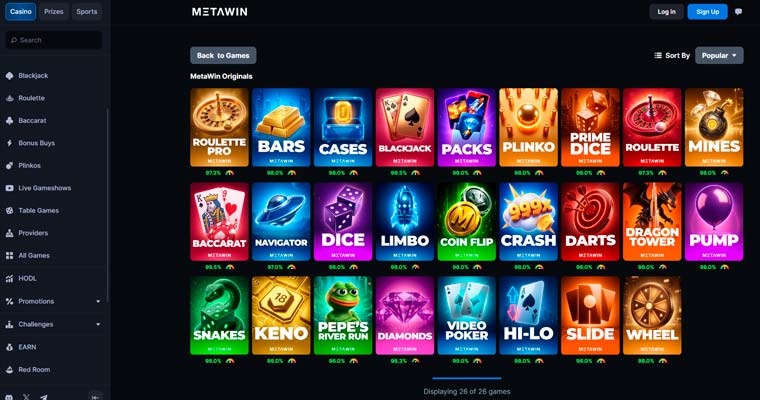
| Were ZERO games found in the checked casino UI? | No. The September 24 check showed 27 regular Originals and a search for “zero” returned no results. | This is the strongest evidence of player-facing availability in the checked session. |
| Does MetaWin still publish ZERO games elsewhere? | Yes. The public Originals catalogue currently lists Dragon Tower ZERO and Limbo ZERO at 100% RTP. | The catalogue and live casino UI are not synchronized. |
| Does the $25,000 cap model still matter? | Yes as retained Zero House Edge documentation and historical/current catalogue context. | Apply it only after confirming the exact ZERO game is actually accessible. |
Verified Quick Facts
| Current operator | Rivolo Limited, Charlestown, Nevis |
| Nevis company number | C62588 |
| Current published licence | Anjouan licence ALSI-202602025-FI1 |
| Live casino check | 27 regular Originals; no ZERO-labelled title found; search for “zero” returned no results |
| Public catalogue | Still lists Dragon Tower ZERO and Limbo ZERO at 100% RTP on page 2 |
| Retained Zero House Edge documentation | Older Terms/FAQ wording still refers to the category and $25,000 maximum-win rule |
| Standard Originals | Current public catalogue primarily shows positive-edge games, generally below 100% RTP |
| Fairness model | Server seed, client seed and nonce verification for Originals |
| KYC | Risk-based controls; Terms allow temporary holds during AML/KYC verification |
| Review classification | Live-product / public-documentation mismatch |
Current ZERO Game Availability: Live UI vs Public Catalogue
The September 24 live casino check and MetaWin’s public catalogue do not currently tell the same story. For current cross-casino availability, see cross-casino 100% RTP game availability.
| Source | What It Shows | Audit Reading |
|---|---|---|
| Checked casino Originals UI | 27 regular Originals; no ZERO-labelled title | |
| Casino search | Search for “zero” returned no results | |
| Public Originals catalogue, page 2 | Dragon Tower ZERO — 100%; Limbo ZERO — 100% | |
| Older Terms / FAQ wording | Zero House Edge concept and $25,000 cap language retained |
If a ZERO Game Is Accessible: The $25,000 Rule
MetaWin’s retained Zero House Edge terms state that the maximum win on a Zero House Edge Original is limited to the equivalent of $25,000 per individual game or round. Because the September live casino check did not surface an active ZERO title, the cap calculations below should be read as conditional mechanics: they apply only after the player confirms that the exact ZERO game is accessible and the same cap wording still governs it.
Cap-Safe Stake Formula
| Target Multiplier | Maximum Cap-Safe Stake | Example Above Threshold | Cap Result |
|---|---|---|---|
| 10x | $2,500 | Usually above current game stake limits | Cap unlikely at ordinary stakes |
| 100x | $250 | $300 | $30,000 fair payout becomes $25,000 |
| 250x | $100 | $100 is exactly cap-safe | No truncation |
| 1,000x | $25 | $100 | $100,000 fair payout becomes $25,000 |
| 10,000x | $2.50 | $3 | $30,000 fair payout becomes $25,000 |
How the Cap Changes Effective RTP
For a fair fixed-target binary bet with win probability p and fair gross multiplier 1/p:
If the target multiplier is 10,000x, the fair win probability is 0.01%. The examples below assume that the game allows those stake and multiplier combinations.
| Stake | Fair Payout | Paid Under Cap | Actual Multiplier | Cap-Adjusted RTP |
|---|---|---|---|---|
| $1 | $10,000 | $10,000 | 10,000x | 100% |
| $2.50 | $25,000 | $25,000 | 10,000x | 100% |
| $3 | $30,000 | $25,000 | 8,333.33x | 83.33% |
| $5 | $50,000 | $25,000 | 5,000x | 50% |
| $10 | $100,000 | $25,000 | 2,500x | 25% |
These figures apply to that specific fixed-target configuration, not automatically to the whole game.
Mines ZERO: Earlier Cap-Sensitivity Example
Earlier 2026 checks documented Mines ZERO at 100% RTP with a $25,000 maximum potential payout, $0.10 minimum bet and $100 maximum bet. That example remains useful for showing how a hard cap can reduce effective RTP, but Mines ZERO was not found in the September 24 live casino check.
| Earlier $100 Target | Fair Uncapped Payout | Capped Payout | Configuration RTP |
|---|---|---|---|
| 100x | $10,000 | $10,000 | 100% |
| 250x | $25,000 | $25,000 | 100% |
| 500x | $50,000 | $25,000 | 50% |
| 1,000x | $100,000 | $25,000 | 25% |
For a multi-outcome game, total cap-adjusted RTP must be calculated by replacing every affected payout with its capped value and summing probability × actual payout.
Standard Originals Are Not ZERO Games
The current public Originals catalogue mostly shows ordinary positive-edge titles. Examples include MetaWin Blackjack and Baccarat at 99.5%, MetaWin Roulette at 97.3%, and many other Originals around 97%–98%. These standard entries should not inherit the economics of older or separately listed ZERO variants.
The practical rule is simple: if the exact live game is not labelled ZERO and the current rules do not show the Zero House Edge model, treat it as the standard positive-edge version.
Provably Fair Evidence
MetaWin says all Originals combine a hidden server seed, player-set client seed and nonce. The server seed is hashed before play and revealed after the round for verification.
| Question | Provably Fair Check | Separate Audit |
|---|---|---|
| Was the result consistent with disclosed seeds? | Yes, with the complete algorithm. | Confirm the exact game version. |
| Is the displayed RTP 100%? | No. | Audit probabilities and gross payouts. |
| Did the $25K cap alter settlement? | No. | Compare uncapped and paid amounts. |
| Is the platform safe or solvent? | No. | Licence, Terms, KYC and withdrawal review. |
Use the Provably Fair Checker only when its selected algorithm matches the MetaWin game being tested.
Operator, Licence and KYC Risk
The current MetaWin footer states that the site is owned and operated by Rivolo Limited in Nevis and operates under Anjouan licence ALSI-202602025-FI1. These details replace older operator and licence information found in previous reviews.
| Risk Area | Current Reading | Review Position |
|---|---|---|
| Operator transparency | Rivolo Limited, address and company number are published. | |
| Licence | Anjouan licence number is displayed sitewide. | |
| KYC and AML | Terms permit temporary holds during verification. | |
| Web3 access | Wallet integration adds signing and wallet-security risks. | |
| Consumer recourse | Offshore regulator rather than a mature high-protection market. |
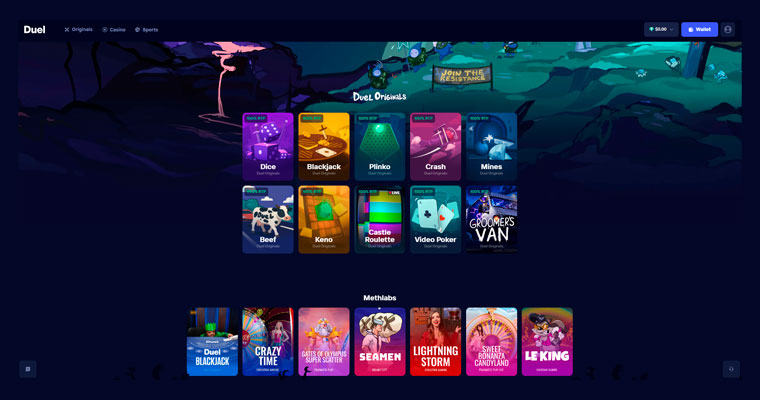
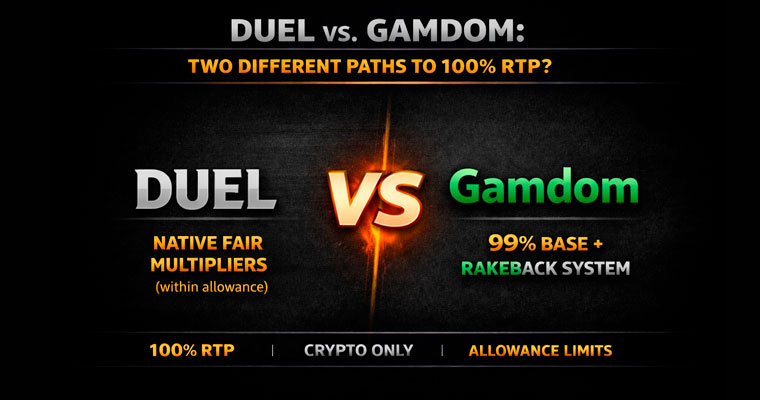
MetaWin vs Duel and Gamdom
| Platform | Primary Fair-Return Model | Main Limitation | Core Audit |
|---|---|---|---|
| MetaWin | ZERO product / catalogue mismatch | Live availability unresolved; retained $25,000 cap wording | Confirm live game first, then audit cap-adjusted payout |
| Duel | $50,000 daily Zero Edge allowance with game-specific implementations | Eligible volume and complex-game exceptions | Tracker, displayed base pricing and completed result |
| Gamdom | $5,000 daily Zero Edge band plus wider rewards documentation | Separate first-$50K wording and personalised rewards | Live Zero Edge panel plus actual rewards divided by eligible turnover |
How to Audit a MetaWin ZERO Bet
- Confirm the exact game is actually accessible: do not rely on a public catalogue entry alone. If the live casino UI does not expose the ZERO title, stop the ZERO audit there.
- Record the stake: if the game is live, use the amount actually debited.
- Record the target multiplier: use the chosen cashout state.
- Calculate uncapped payout: stake × multiplier.
- Apply the $25,000 ceiling: use the lower amount.
- Recalculate effective RTP: replace capped payouts in the distribution.
- Verify the result separately: use the exact seed and game algorithm.
- Test account flow: complete a small withdrawal before increasing exposure.
Frequently Asked Questions
Are MetaWin ZERO games currently available?
They were not found in our September 24 live casino check: the interface showed 27 regular Originals and a search for “zero” returned no results. However, MetaWin’s public catalogue still lists Dragon Tower ZERO and Limbo ZERO at 100% RTP, so the operator’s surfaces are currently inconsistent.
Which ZERO titles are still visible in MetaWin’s public catalogue?
At the current public catalogue check, page 2 lists Dragon Tower ZERO and Limbo ZERO at 100% RTP. That catalogue evidence does not by itself prove the games are accessible in the live casino UI.
Does the $25,000 cap apply to every ZERO game?
MetaWin’s Terms state that the maximum win on any Zero House Edge Original is $25,000 per individual game or round.
How do I avoid the cap?
Keep stake × target multiplier at or below $25,000. The cap-safe stake equals $25,000 divided by the target multiplier.
Can the cap reduce RTP below 100%?
Yes. Once the fair payout exceeds the cap, the actual multiplier becomes smaller than the fair multiplier.
Are all MetaWin Originals provably fair?
MetaWin states that all Originals use server seed, client seed and nonce verification. This does not mean every Original has 100% RTP.
Who currently operates MetaWin?
The current site footer identifies Rivolo Limited and Anjouan licence ALSI-202602025-FI1.
Is MetaWin no-KYC?
No guarantee should be assumed. The Terms and KYC Policy allow compliance verification and temporary holds.
Our Verdict
Classification: unresolved live-product / public-catalogue mismatch with retained Zero House Edge documentation.
The strongest current player-facing evidence is the September casino check, which found no ZERO-labelled titles. The strongest conflicting evidence is MetaWin’s own public catalogue, which still lists ZERO games at 100% RTP. Until those surfaces are synchronized, the site should not be presented as a confirmed active Zero House Edge casino.
The $25,000 cap remains an important mathematical warning if a ZERO title becomes accessible: any cap-binding outcome reduces the effective return below the uncapped 100% claim. But the first audit step is now availability, not cap arithmetic.