What to Verify Before Trusting Duel Crash RTP
Crash has clean target math, but the full audit still depends on the live allowance state, bust-point generation and seed verification.
A fair target x should be reached with probability 1 / x.
Check whether the bet is inside the eligible fair-play allowance.
After the allowance, the same target may use a lower-return distribution.
Reproduce completed crash points with seed or randomness inputs where supported.
Use auto-cashout to reduce hesitation, latency and manual timing errors.
| Provider | Duel Originals |
| Game Type | Rising multiplier crash game |
| Core Mechanic | Cash out before the multiplier busts |
| Fair RTP Reference | P(reach target x) = 1 / x |
| Stated Return | Fair pricing inside the eligible allowance |
| Post-Allowance | Reported 99.9% return / 0.1% edge |
| Allowance | Shared daily wager allowance across eligible Duel Originals |
| Max Bet | Reported $1,000 eligible bet limit |
| Auto Cashout | Yes |
| Verification | Seed-based outcome verification; exact implementation should be checked in the platform verifier |
Audit status: Duel Crash has a strong target-math audit path because the fair auto-cashout model is simple. We treat P(reach x) = 1 / x as the no-margin reference distribution. Sample Duel Crash outcomes have been reproduced through the verification flow, but this page does not claim a full source-code or large-sample distribution audit.
For the allowance model, read zero-edge allowance explained. For completed-round verification, use the Provably Fair Checker. For bankroll risk, see why fair games can still lose money short term. For the broader platform context, see the Duel Casino audit.
Duel Crash RTP in One Minute
| Question | Short Answer | Audit Note |
|---|---|---|
| What is the fair RTP model? | A target x should hit with probability 1 / x. | At 2.00x, fair probability is 50%; at 10.00x, it is 10%. |
| Is Duel Crash automatically 100% RTP? | No. It depends on allowance state and the active pricing mode. | Check the live tracker before assuming fair pricing applies. |
| What happens after the allowance? | A reported post-cap edge may apply. | A 99.9% model means roughly $0.10 expected cost per $100 wagered. |
| Does auto-cashout improve EV? | No. | It improves execution discipline, not the mathematical return. |
| Does provably fair verification prove RTP? | No. | It verifies completed outcomes; RTP requires distribution and pricing checks. |
What Is Duel Crash?
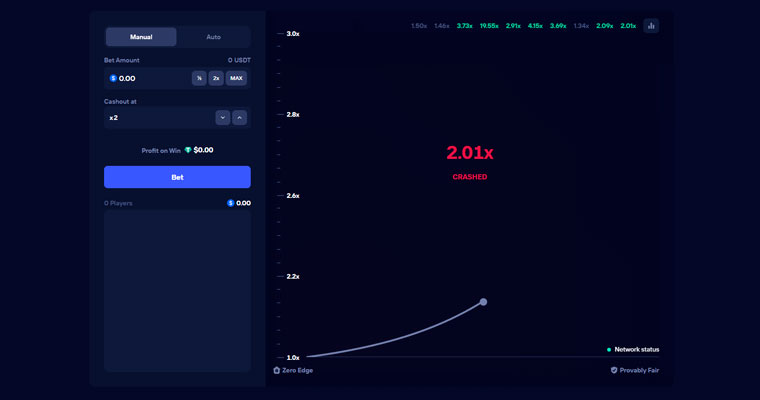
Crash is a timing game. A multiplier starts at 1.00x and rises until it busts. You place your bet before the round starts, then either cash out before the bust or lose the stake. If you cash out at 2.00x, a $10 bet returns $20. If the round busts before your cashout point, the payout is $0.
Duel’s version is notable because it is positioned as a fair-priced Original inside the platform’s eligible allowance. After the allowance is exhausted, a small post-cap edge is reported to apply. That makes the game materially cheaper than typical crash products while the allowance is active, but it does not remove volatility.
Duel Crash RTP and House Edge
The clean way to audit Crash is to separate target selection, return mode and outcome verification. Target selection changes hit frequency and volatility. Return mode changes expected cost. Outcome verification checks whether a completed bust point was generated consistently from the disclosed randomness process.
| Return Mode | Reference Formula | Meaning | Expected Cost per $100 Wagered |
|---|---|---|---|
| 100% RTP / fair model | P(reach x) = 1 / x | No built-in margin before limits, rounding or execution issues. | $0 theoretical cost |
| 99.9% RTP / 0.1% edge | P(reach x) = 0.999 / x | Very low-cost post-cap or adjusted mode. | About $0.10 |
| 99% RTP / 1% edge | P(reach x) = 0.99 / x | Common crypto crash pricing reference. | About $1 |
| 97% RTP / 3% edge | P(reach x) = 0.97 / x | Typical higher-cost crash/game-show territory. | About $3 |
The important point is that the target does not create a better expected value by itself. A 2.00x target and a 10.00x target can both have the same theoretical return if each is priced from the same distribution. The difference is variance.
Crash Auto-Cashout Math
The Fair 1/x Model
In a fair crash distribution, any auto-cashout target x should satisfy:
P(reaching x) = 1 / x
Expected value is then:
EV = P(reaching x) × x = 1.00
At 2.00x, the fair win rate is 50%. At 5.00x, it is 20%. At 10.00x, it is 10%. The higher target does not create a better expected result; it creates a more volatile distribution.
What a Lower-Return Version Changes
A 99% version keeps roughly 1% for the operator over time. One common way to express that is:
P(reaching x) = 0.99 / x
At 2.00x, that means about 49.5% instead of 50%. At 10.00x, about 9.9% instead of 10%. The difference looks small per round, but it compounds over volume.
What About Instant Busts?
Crash games can handle 1.00x busts in different ways. Some algorithms use forced instant-bust events to create a house edge. Others use a continuous distribution where an exact 1.00x result is rare or implementation-dependent. The important point is that the whole distribution determines the return, not one visible bust point.
For Duel specifically, do not assume the exact bust-generation method unless you have verified it through the platform’s current fairness tool and documentation. The clean reference model is 1/x for fair pricing and an adjusted version for lower-return modes.
What Provably Fair Proves
Provably fair verification shows whether a completed round can be reproduced from the disclosed seeds or randomness inputs. It can help confirm that the casino did not change the outcome after bets were placed.
It does not, by itself, prove the long-term RTP. A crash game can be provably fair and still be priced at 99%, 97% or another return level. RTP requires checking the distribution formula, observed sample behavior and paytable logic separately.
How to Audit the Live Duel Crash Table
- Check the allowance tracker: confirm whether the current bet is inside the 100% RTP window or in a post-cap state.
- Set a fixed auto-cashout target: choose the target before the round starts so execution does not depend on reaction time.
- Compare target probability: use the fair reference model where a 2.00x target should be reached about 50% of the time and a 5.00x target about 20% of the time.
- Save completed-round data: record round ID, displayed bust point, seed data or verifier inputs where available.
- Reproduce the bust point: use Duel’s verifier or the Provably Fair Checker if the mode is supported.
- Separate RTP from randomness: a matching bust point verifies outcome generation, while RTP requires checking the full distribution and active return mode.
The Allowance in Practice
The allowance matters because it defines which pricing state applies. If the eligible window is active, the game should be evaluated against the fair model. If it is exhausted, post-cap pricing may apply.
| Bet Size | Approx. Time to $50K at 120 Rounds/Hour | Practical Meaning |
|---|---|---|
| $5 | ~83 hours | Unlikely to matter in normal manual play |
| $50 | ~8 hours | Relevant only for long sessions |
| $100 | ~4 hours | Can matter for sustained play |
| $500 | ~50 minutes | High-volume players can exhaust it quickly |
| $1,000 | ~50 rounds / ~25 minutes | Maximum-stake play reaches the limit fast |
These are turnover estimates, not profit forecasts. The allowance counts wagered volume, regardless of whether a round wins or loses.
Auto-Cashout Targets
In the fair reference model, each target has the same expected value but a different hit rate and variance profile.
| Target | Fair Reach Probability | Profit if $1 Stake Wins | Variance Profile |
|---|---|---|---|
| 1.50x | 66.67% | $0.50 | Lower |
| 2.00x | 50.00% | $1.00 | Medium |
| 3.00x | 33.33% | $2.00 | Medium-high |
| 5.00x | 20.00% | $4.00 | High |
| 10.00x | 10.00% | $9.00 | Very high |
| 50.00x | 2.00% | $49.00 | Extreme |
Auto-cashout also removes timing risk. Manual cashout can be affected by hesitation, device lag or network delay. If you already know your target before the round starts, auto-cashout is usually the cleaner implementation.
Disconnect note: If your connection drops mid-round and no auto-cashout is set, the result may depend on the platform’s current rules. Check the live terms or support documentation before relying on manual cashout for larger bets.
What Fair Pricing Changes
It changes expected cost. At a 1% edge, $1,000 of total wagers costs about $10 in theoretical loss. At a 3% edge, the expected cost is about $30. At fair pricing, the theoretical cost before limits and variance is $0.
It does not change volatility. A sequence of early busts can still wipe out a session bankroll. A fair game has no built-in downward drift, but short-term outcomes can still be severe.
It does not make prediction possible. Past crash results do not forecast future bust points. Any service claiming to predict the next round should be treated as a scam. See Provably Fair Predictor Scams for the full breakdown.
Duel Crash vs Other Versions
| Feature | Duel | Gamdom | Stake | Aviator / Spribe |
|---|---|---|---|---|
| Published Return Model | Fair pricing inside allowance; post-cap low-edge model reported | Hybrid model: base RTP plus rewards and instant return layer on selected volume | 99% RTP / 1% house edge | Commonly listed around 97% RTP |
| Eligible Volume | Reported $50,000 daily allowance | Current help wording refers to the first $50,000 wagered on selected games | No fair-play allowance | No fair-play allowance |
| Verification | Seed-based verifier; sample outcomes reproduced | In-game verifier and account-level return layer | Provably fair | Provider-side RNG/certification model varies by operator |
| Auto Cashout | Yes | Yes | Yes | Yes |
| Main Caveat | Allowance status and full distribution audit still matter | Reset and post-threshold behavior need live verification | Built-in 1% cost | Higher built-in cost and operator-specific terms |
The table should not be read as a universal ranking of crash games. It compares pricing structure and auditability. Stake has a mature crash product with clear 99% RTP. Aviator is widely distributed but commonly carries a higher edge. Gamdom and Duel are more relevant for players specifically comparing fair-return crypto Originals.
Strategy Context
There is no auto-cashout target that beats the game in a fair 1/x model. Target selection only changes result shape.
- Low targets: more frequent wins, smaller profit per win, smoother sessions.
- Medium targets: balanced hit rate and payout size.
- High targets: long losing streaks, rare large wins, much wider drawdowns.
The most useful strategy choice is not a secret target. It is pre-commitment: choose a cashout point, set auto-cashout, define a loss limit and avoid changing the target after seeing early round movement.
Related RTP and Fairness Checks
- Zero-edge allowance explained — how the 100% RTP window, cap and post-cap state work
- Provably Fair Checker — seed and bust-point verification for completed rounds
- Provably fair predictor scams — why crash signals and prediction tools are not reliable
- Duel Dice RTP audit — simpler fair multiplier math without timing execution
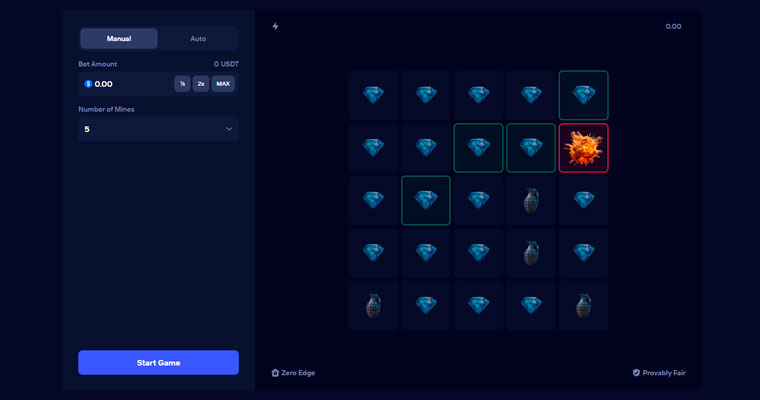
- Duel Mines audit — probability and multiplier checks for grid-reveal play
Frequently Asked Questions
Is Duel Crash really 100% RTP?
Duel Crash is promoted as fair-priced inside the eligible allowance, with a reported low-edge post-cap mode after the allowance is used. The correct audit is to check the live allowance state, then verify completed bust points where seed data is available.
What is the fair crash formula?
In the no-margin reference model, a target x should be reached with probability 1 / x. That means 2.00x should hit about 50% of the time, 5.00x about 20% of the time and 10.00x about 10% of the time.
Does auto-cashout improve the RTP?
No. Auto-cashout does not change expected value. It reduces manual execution risk by locking the target before the round starts.
How does Duel make money on Crash?
The likely model is that fair-priced Originals attract players, while revenue comes from third-party slots, live casino, sportsbook margin, post-allowance play and broader retention. Crash itself is not the whole business model.
What happens at a 1.00x bust?
You lose the stake. The frequency and handling of exact 1.00x events depends on the algorithm. The important audit question is whether the full distribution matches the published return model.
Can I predict the next crash point?
No. A valid crash game must make each round independent and unpredictable before reveal. Prediction apps, signals and pattern systems should be treated as fraudulent.
Bottom Line
Duel Crash is attractive because its reported pricing is much cheaper than typical crash games while the eligible allowance is active. The fair reference model is simple: a 2x target should hit about half the time, a 5x target about one fifth of the time, and a 10x target about one tenth of the time.
The cautious conclusion is that the game has strong mathematical plausibility and a useful verification path, but the full bust-distribution implementation still matters. Before playing high volume, confirm the allowance state, use auto-cashout for execution discipline, and verify completed rounds through the fairness tool.