What to Verify Before Trusting Duel Plinko RTP
Plinko has clean probability math, but the return depends on the exact lane multipliers for the selected rows and risk level.
Confirm the selected row count, usually 8–16 rows in modern crypto Plinko games.
Low, medium and high risk change the lane multiplier distribution.
Use C(N, k) / 2N for each lane from left to right.
Record every payout and compute the weighted average return.
Check whether fair pricing or post-allowance pricing applies.
| Question | Short Answer | Audit Note |
|---|---|---|
| Is Duel Plinko automatically 100% RTP? | No. The lane table must be checked for the selected rows and risk level. | Binomial odds are fixed, but payout calibration determines RTP. |
| What determines Plinko RTP? | The weighted average of every lane probability and multiplier. | Expected return = ∑ P(lane) × multiplier(lane). |
| Does risk level change EV? | Only if the risk tables are calibrated to different returns. | Normally it mainly changes variance and payout concentration. |
| Does provably fair prove RTP? | No. It can verify the path or outcome, not the lane pricing. | Randomness verification and RTP verification are separate checks. |
| What should be checked live? | Rows, risk level, lane multipliers, allowance tracker, post-cap state and max payout. | These are product rules, not permanent mathematical constants. |
| Provider | Duel Originals |
| Game Type | Ball-drop multiplier game |
| Rows | Reported 8–16, configurable |
| Risk Levels | Low, Medium, High |
| Probability Model | Binomial distribution: C(N, k) / 2N |
| Stated Return | Fair pricing inside the eligible allowance, subject to live lane-table confirmation |
| Post-Allowance | Reported 99.9% return / 0.1% edge on eligible simple Originals; verify live state |
| Allowance | Shared daily wager allowance across eligible Originals |
| Max Bet | Reported $1,000 eligible bet limit |
| Max Multiplier | Up to about 1,000x in high-risk settings, verify live |
| Verification | Seed-based path verification; payout table must be checked separately |
Audit status: The binomial probability model is mathematically exact. What remains to verify is the full lane multiplier table for each row and risk setting. We have not extracted every Duel Plinko payout table line by line, so the practical audit is to compute the weighted average from the live UI before assuming a specific return.
For the wider allowance model, read zero-edge allowance explained. For outcome checks, use the Provably Fair Checker. For the full platform context, see the Duel Casino review.
What Is Duel Plinko?
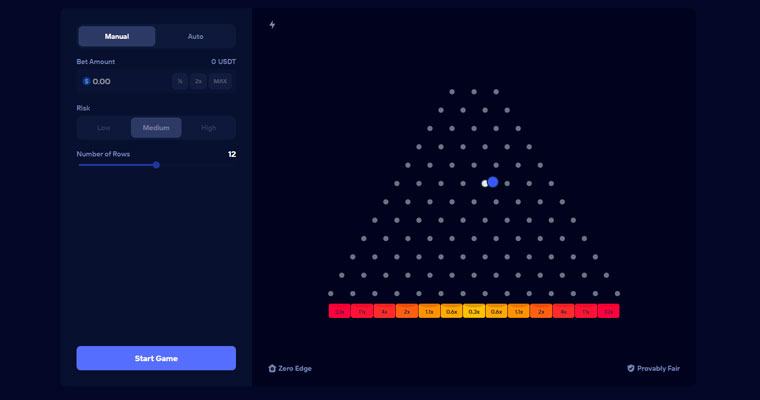
Plinko is a ball-drop game. You choose a number of rows and a risk level, then drop a ball through a pegged board. At each peg, the path moves left or right. The final lane determines the multiplier applied to your stake.
The game is simple to watch but less simple to price. The board probabilities are fixed by combinatorics, while the payout table is set by the operator. Two Plinko games can have the same visual board and very different expected returns if their lane multipliers differ.
Duel’s version is positioned as a fair-priced Original while the eligible allowance is active. That claim is plausible within the standard Plinko framework, but it must be checked by summing the live lane multipliers against the correct binomial probabilities.
Duel Plinko RTP and House Edge
Plinko RTP is a weighted-average calculation. For a selected row count and risk setting, each lane has a probability and a multiplier. The sum of probability × multiplier across all lanes gives the theoretical return for that exact table.
| Return State | Expected Sum | House Edge | What to Check |
|---|---|---|---|
| Fair / 100% RTP table | 1.0000 | 0.00% | The full lane table sums to one bet unit before caps and rounding. |
| 99.9% post-cap table | 0.9990 | 0.10% | The same table or return layer is slightly reduced after allowance use. |
| 99% table | 0.9900 | 1.00% | Common crypto Plinko benchmark on platforms without zero-edge allowance. |
| 97% table | 0.9700 | 3.00% | More typical of higher-cost casino games or provider-configured versions. |
A high top multiplier does not prove a better return. It usually means more value has been moved into rare edge lanes, while center lanes pay less. The RTP can be identical across low, medium and high risk if each table is calibrated to the same weighted sum.
How Plinko Math Works
Binomial Distribution
Each row adds one left/right event. With N rows, the ball has N + 1 possible landing lanes. The probability of landing in lane k, counting from the left, is:
P(lane k) = C(N, k) / 2N
This creates a bell-shaped distribution. Center lanes are common. Edge lanes are rare.
| Rows | Lanes | Single Edge Lane Probability | Center Lane Probability |
|---|---|---|---|
| 8 | 9 | 0.3906% / 1 in 256 | 27.34% |
| 12 | 13 | 0.0244% / 1 in 4,096 | 22.56% |
| 16 | 17 | 0.0015% / 1 in 65,536 | 19.64% |
These probabilities are the same for any standard Plinko board with fair left/right movement. The operator edge comes from the multiplier table, not from the binomial formula itself.
Where the Edge Lives
The expected return is the weighted average of all lane outcomes:
Expected return = ∑ P(lane k) × multiplier(lane k)
If the sum is 1.0000, the table is fair before limits and rounding. If the sum is 0.9900, the table has a 1% edge. If the sum is 0.9700, it has a 3% edge.
This is why Plinko can look identical across platforms while having different long-term costs. The ball path distribution may be the same, but the lane payments can be calibrated differently.
Rounding caveat: A displayed multiplier table may be rounded for readability. Small rounding differences can move the true weighted average slightly above or below the headline value. For exact checking, use the live values shown in the game and repeat the calculation for the specific row and risk setting.
Risk Levels and Rows
Risk level does not change the binomial path. It changes how aggressively the lane multipliers are distributed.
| Risk | Typical Center Lanes | Typical Edge Lanes | Variance | Session Feel |
|---|---|---|---|---|
| Low | Closer to break-even or small partial returns | Modest top multipliers | Lower | More stable, fewer extreme outcomes |
| Medium | Lower center returns | Higher edge payouts | Medium | Balanced, with visible upside |
| High | Often heavy partial-loss lanes | Rare large multipliers | Very high | Long drawdowns with occasional large hits |
More rows create more possible lanes and rarer edge hits. At 16 rows, a single far-edge lane has only a 1 in 65,536 probability. That is why high-risk 16-row boards can advertise very large top multipliers while still producing long losing stretches.
How to Audit the Live Duel Plinko Table
The clean audit must be run separately for each row count and risk setting. A 12-row medium-risk table and a 16-row high-risk table are different games from an RTP perspective.
- Choose the exact setting: rows and risk level.
- Write down every lane multiplier: from the far left lane to the far right lane.
- Calculate lane probabilities: use C(N, k) / 2N for k = 0 through N.
- Multiply each lane probability by its multiplier.
- Sum the results: 1.0000 means fair pricing, 0.9900 means about 99% RTP, and so on.
- Check allowance status: if the fair-play cap is exhausted, compare against the post-cap return state instead.
- Check maximum payout limits: a max-win cap can lower effective return on high-stake, high-multiplier settings.
- Verify completed paths where possible: use seed data to confirm that a finished ball path or lane outcome matches committed randomness.
This checks payout calibration and randomness separately. The weighted-average table tells you the RTP. The provably fair check tells you whether a completed path or lane result matches the disclosed randomness process.
What Fair Pricing Changes
Fair pricing changes expected cost, not volatility. If the weighted average equals 1.0000, the theoretical cost of the drop is zero before limits, caps and rounding. If the weighted average equals 0.9900, the expected cost is about $1 per $100 wagered.
- No mathematically best risk level: low, medium and high can have the same expected value if all tables are calibrated to the same return.
- Different session shape: low risk concentrates results near the center; high risk pushes more value into rare edge lanes.
- Real bankroll swings: a fair game can still produce large short-term losses, especially on high-risk boards.
A high top multiplier does not mean a better game. It means the payout table is more volatile.
Duel Plinko vs Other Versions
| Feature | Duel | Gamdom | Stake | Third-Party Plinko |
|---|---|---|---|---|
| Published Return Model | Fair pricing inside allowance; low-edge post-allowance model reported | Hybrid model: around 99% base RTP plus rewards and instant return layer on selected volume | 99% RTP / 1% house edge | Varies by provider and operator configuration |
| Rows | Reported 8–16 | Check live game settings | 8–16 | Usually 8–16, but not universal |
| Risk Levels | Low, Medium, High | Check live game settings | Low, Medium, High | Provider-specific |
| Max Multiplier | Up to about 1,000x, verify live | Game-specific | Up to 1,000x | Usually capped; varies widely |
| Verification | Seed-based verification plus table audit needed | In-game verifier plus reward-layer checks | Provably fair outcome checks | Often provider-certified rather than user-verifiable |
| Main Caveat | Full live lane table should be summed for the selected setting | Hybrid return structure is not identical to native lane calibration | Clear 1% cost over volume | RTP may differ by operator, region and configuration |
The same board shape does not guarantee the same price. Always compare the lane multipliers, not only the row count and maximum multiplier.
Strategy Context
There is no risk setting that beats a correctly priced Plinko table. The useful decision is variance selection.
- Low risk: better for longer sessions and smaller drawdowns.
- Medium risk: more visible upside without fully concentrating value in the far edges.
- High risk: best suited only for players who accept long losing stretches and rare large hits.
Before using high-risk 16-row settings, remember the far-edge probability: about 1 in 65,536 per edge lane. Large multipliers exist because those outcomes are rare.
Related RTP and Fairness Checks
- Zero-edge allowance explained — how fair-play caps and post-cap pricing affect eligible Originals
- Provably Fair Checker — seed-based result verification where the game mode is supported
- Duel Casino review — platform-level review of RTP claims, limits and risk
- Duel Dice RTP audit — fixed inverse-probability pricing model
- Duel Mines RTP audit — combinatorial survival odds and payout-table checks
Frequently Asked Questions
Is Duel Plinko really 100% RTP?
It may fit Duel’s fair-play model while the allowance is active, but the exact answer requires checking the live lane table for the selected rows and risk setting. The correct method is to multiply every lane probability by its multiplier and sum the results.
What is the formula for Duel Plinko odds?
The standard Plinko lane formula is C(N, k) / 2N, where N is the number of rows and k is the lane index counted from one side of the board.
Can I aim the ball?
No. In a valid Plinko game, each left/right movement should be determined by the game’s randomness system. The player chooses the settings and bet size, not the exact path.
Which risk level is best?
There is no universal best risk level if each table is calibrated to the same return. Low risk is smoother. High risk is more volatile. The right setting depends on bankroll tolerance, not on hidden profitability.
How rare is a 1,000x hit?
On a 16-row board, a single far-edge lane has a probability of 1 / 65,536, or about 0.0015%. If the largest multiplier sits on one or both edge lanes, hits will be extremely rare.
It is reported as one of the eligible Originals sharing the daily allowance with other simple games such as Dice, Crash, Mines and Keno. Check the live tracker before assuming the allowance is active.
Does provably fair prove the RTP?
No. It can verify the generated path or outcome, but the RTP comes from the lane multipliers. You need both the fairness check and the weighted-average calculation.
Bottom Line
Plinko is mathematically transparent once you separate the two pieces: landing probability and lane pricing. The probabilities come from the binomial formula. The player return comes from the multiplier table.
For Duel, the fair-pricing claim is plausible within the standard Plinko model, but the clean audit is to extract the exact lane multipliers for each row and risk setting, then compute the weighted average. Until that table is checked line by line, the safest conclusion is formula-verified probability math with payout-table verification still needed.