What to Verify Before Trusting Duel Keno RTP
Keno has clean probability math, but the return claim depends on the live multiplier table for each pick count.
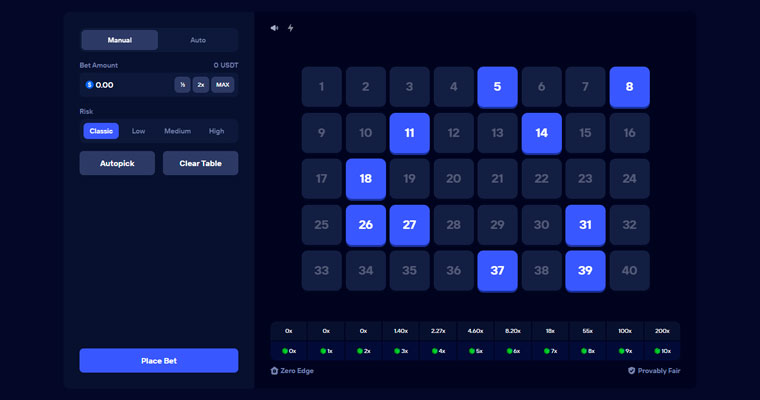
Confirm the 40-number board, 1–10 player picks and 10 drawn numbers.
Record every multiplier for each match count before calculating RTP.
Multiply each match probability by its payout and sum all rows.
Check whether the fair-play window is active or post-cap pricing applies.
Use seed-based checks to confirm completed number draws where supported.
| Question | Short Answer | Audit Note |
|---|---|---|
| Is Duel Keno automatically 100% RTP? | No. The probability model is exact, but the live paytable must be summed. | Do not treat a headline RTP claim as verified until the table is checked row by row. |
| What determines Keno RTP? | The weighted sum of match probabilities and multipliers. | Every pick count has a separate return profile unless the operator calibrates all tables equally. |
| Does provably fair prove the RTP? | No. It can verify the draw, not the payout calibration. | Outcome fairness and paytable fairness are separate checks. |
| Does pick count change EV? | Only if the paytables differ by return level. | If tables are equally calibrated, pick count mostly changes variance. |
| What should be checked live? | Paytable, allowance tracker, post-cap state, max payout and draw verifier. | These are live product rules, not permanent mathematical constants. |
| Provider | Duel Originals |
| Game Type | Number-pick draw game |
| Grid | 40 numbers |
| Player Picks | Reported 1–10 |
| Numbers Drawn | 10 |
| Probability Model | Hypergeometric distribution |
| Stated Return | Fair pricing inside the eligible allowance, subject to live paytable confirmation |
| Post-Allowance | Reported 99.9% return / 0.1% edge on eligible simple Originals; verify live status |
| Allowance | Shared daily wager allowance across eligible Originals |
| Max Bet | Reported $1,000 eligible bet limit |
| Verification | Seed-based draw verification; paytable audit required separately |
Audit status: The probability framework is verified by exact combinatorial math. The unresolved part is the live Duel Keno paytable: each multiplier for each match count must be extracted from the game interface before the final expected return can be confirmed.
For the broader allowance model, read zero-edge allowance explained. For outcome verification, use the Provably Fair Checker. For the full platform review, see the Duel Casino audit.
What Is Duel Keno?
Keno is a number-picking game. You select between 1 and 10 numbers from a 40-number grid. The game draws 10 numbers at random. Your payout depends on how many of your selected numbers match the draw.
The game has no timing decision, no card strategy and no in-round cashout choice. Once you choose your numbers and place the bet, the round is determined by the draw and the paytable.
That makes Duel Keno easy to analyze in one way and incomplete without live data in another. The odds can be calculated exactly. The effective RTP depends on the multipliers attached to each match count, any allowance state, any post-cap pricing and any maximum-payout rule.
Duel Keno RTP and House Edge
The Keno RTP calculation is a weighted average. For a selected pick count, every possible match count has a probability and a payout. To audit the return, multiply each probability by the corresponding multiplier, then sum the results.
| Return State | Expected Sum | House Edge | What to Check |
|---|---|---|---|
| Fair / 100% RTP table | 1.0000 | 0.00% | The full paytable sums to one bet unit before caps and rounding. |
| 99.9% post-cap table | 0.9990 | 0.10% | The same paytable or return layer is slightly reduced after allowance use. |
| 99% table | 0.9900 | 1.00% | Common low-edge crypto Keno benchmark. |
| Traditional low-return Keno | Often much lower | Varies widely | Venue paytables can be materially worse than crypto-original tables. |
The important point is that there is no single “Keno RTP” unless the pick count and paytable are known. A 5-pick table and a 10-pick table can be calibrated to the same return, but that must be verified rather than assumed.
The Probability Formula
Keno probabilities use the hypergeometric distribution. With 40 numbers on the board, 10 numbers drawn, k player picks and m matches, the exact probability is:
P(m) = C(k, m) × C(40 − k, 10 − m) / C(40, 10)
The denominator is:
C(40, 10) = 847,660,528
That means there are 847,660,528 equally likely 10-number draw combinations. The formula tells you how many of those combinations produce each match count.
Example: 5 Picks
| Matches | Exact Probability | Raw Inverse Probability | Paytable Status |
|---|---|---|---|
| 0 / 5 | 21.657% | 4.62x | Usually loss or no return |
| 1 / 5 | 41.648% | 2.40x | Depends on live paytable |
| 2 / 5 | 27.766% | 3.60x | Check in-game |
| 3 / 5 | 7.933% | 12.61x | Check in-game |
| 4 / 5 | 0.957% | 104.45x | Check in-game |
| 5 / 5 | 0.0383% | 2,611.14x | Check in-game |
Important distinction: The raw inverse probability is not automatically the correct Keno multiplier. A real paytable distributes value across multiple match counts. The full RTP is the weighted sum of every match probability multiplied by its corresponding payout.
How to Audit the Live Duel Keno Paytable
The clean audit is mechanical. It does not require guessing whether a pattern of numbers is lucky. It requires the live game rules and the visible multiplier table.
- Open the Duel Keno rules or paytable. Do this before placing high-volume bets, because live rules can change.
- Choose one pick count. Audit 1-pick, 5-pick and 10-pick tables separately rather than assuming they share one return.
- Record every payout row. Include losing rows, partial-hit rows, perfect-hit rows and any stake-return rows.
- Calculate every match probability. Use the hypergeometric formula for the same board size and draw count.
- Multiply probability by multiplier. Do this for every match count.
- Sum the products. A fair table should sum to 1.0000 before rounding, caps and allowance mechanics.
- Check allowance status. If post-cap pricing is active, compare against the reduced return state instead of the fair table.
- Verify at least one completed draw. Use seed data where the platform exposes server seed, client seed, nonce or equivalent round inputs.
This checks payout calibration and draw integrity separately. The paytable sum tells you the return model. The provably fair check tells you whether a completed draw matches the disclosed randomness process.
Perfect Hit Probabilities
The chance of matching every selected number falls rapidly as the pick count rises.
| Picks | Perfect Hit Probability | Approximately | Variance Profile |
|---|---|---|---|
| 1 | 25.000% | 1 in 4 | Lower |
| 2 | 5.769% | 1 in 17 | Low-medium |
| 3 | 1.215% | 1 in 82 | Medium |
| 4 | 0.230% | 1 in 435 | High |
| 5 | 0.0383% | 1 in 2,611 | High |
| 6 | 0.00547% | 1 in 18,278 | Very high |
| 7 | 0.000644% | 1 in 155,363 | Very high |
| 8 | 0.0000585% | 1 in 1.71 million | Extreme |
| 9 | 0.00000366% | 1 in 27.34 million | Extreme |
| 10 | 0.000000118% | 1 in 847.66 million | Extreme |
A 10/10 hit is roughly a 1-in-847.66-million event. At one round per second, the expected waiting time for one such hit is about 26.9 years of continuous play. The 50% chance point is lower, around 18.6 years, but that is still far beyond any normal session.
This is why high-pick Keno feels lottery-like. Large multipliers exist because the top outcomes are extremely rare.
Variance by Pick Count
At the same return level, pick count changes variance rather than expected value.
- 1–2 picks: more frequent hits, smaller top payouts, smoother session shape.
- 3–5 picks: balanced profile with meaningful but still reachable higher matches.
- 6–10 picks: rare top hits, longer losing stretches, much larger payout concentration.
There is no universally best number of picks if the paytable is correctly calibrated. The best choice is the one that matches bankroll size and tolerance for drawdowns.
Duel Keno vs Other Versions
| Feature | Duel | Gamdom | Stake | Traditional Keno |
|---|---|---|---|---|
| Published Return Model | Fair pricing inside allowance; paytable audit still needed | Hybrid model: around 99% base RTP plus rewards and instant return layer on selected volume | 99% RTP / 1% house edge | Often much lower, varies widely by venue and paytable |
| Grid | 40 numbers | Check live game rules | 40 numbers | Often 40–80 numbers |
| Player Picks | Reported 1–10 | Check live game rules | 1–10 | Can allow more picks |
| Numbers Drawn | 10 | Check live game rules | 10 | Usually game-specific |
| Verification | Seed-based draw verification plus paytable audit needed | In-game verifier plus reward-layer checks | Provably fair outcome checks | Usually not user-verifiable |
| Main Caveat | Full live paytable must be summed before confirming return | Hybrid return structure is not identical to native paytable calibration | Clear 1% cost over volume | Paytables can be very unfavorable |
Keno mechanics can look similar across operators, but payout calibration changes the long-term cost. The probability of matching numbers is fixed by the draw rules; the player return is determined by the paytable.
Strategy Context
Keno is not a game where number patterns create an edge. Birthdays, “hot numbers,” symmetrical layouts and previous draws do not improve the next round. The draw should be independent.
The practical strategy choices are limited:
- Choose pick count by variance: fewer picks for smoother play, more picks for lottery-style swings.
- Check the paytable: do not assume the advertised return applies equally to every pick count.
- Control bet size: high-pick Keno can produce long dry spells even when priced fairly.
- Verify the draw: use the platform’s provably fair tool to check completed rounds.
Related RTP and Fairness Checks
- Zero-edge allowance explained — how fair-play caps and post-cap pricing affect eligible Originals
- Provably Fair Checker — verify completed seed-based outcomes where the game mode is supported
- Duel Casino audit — platform-level review of RTP claims, limits and risk
- Duel Dice RTP audit — simpler inverse-probability pricing model
- Duel Mines RTP audit — combinatorial survival odds and payout-table checks
Frequently Asked Questions
Is Duel Keno really 100% RTP?
It may fit Duel’s fair-play model while the allowance is active, but the final answer requires a live paytable audit. The correct method is to multiply each match probability by its payout and sum the full table for the selected pick count.
What is the formula for Duel Keno odds?
The standard model uses the hypergeometric formula: C(k, m) × C(40 − k, 10 − m) / C(40, 10), where k is your number of picks and m is the number of matches.
Why do I keep losing at Keno even if the paytable is fair?
Because most Keno rounds lose or return less than the stake. The return is concentrated in less frequent match counts. A fair table can still produce long losing stretches, especially with higher pick counts.
Is there a best number of picks?
Not automatically. If every pick count is calibrated to the same return, the difference is variance. Fewer picks are smoother. More picks create rarer, larger wins.
Does choosing special numbers help?
No. In a valid random draw, every number combination has the same probability before the round. Personal patterns do not change the odds.
Keno is reported as one of the eligible Originals sharing the daily allowance with other simple games such as Dice, Crash, Mines and Plinko. Check the live tracker before assuming the allowance is active.
Does provably fair prove the RTP?
No. It can verify the drawn numbers for a completed round. RTP requires checking the paytable by multiplying each match probability by its payout and summing the results.
Bottom Line
Keno has exact probability math but paytable-dependent return. On a 40-number board with 10 drawn numbers, every match count can be calculated with the hypergeometric formula. That part is not subjective.
For Duel, the correct conclusion is cautious: the game fits the platform’s fair-play model, and the probability framework is fully auditable, but the live multiplier table still needs to be extracted and summed before the stated return can be independently confirmed end to end.