

What 100% RTP Removes—and What It Leaves
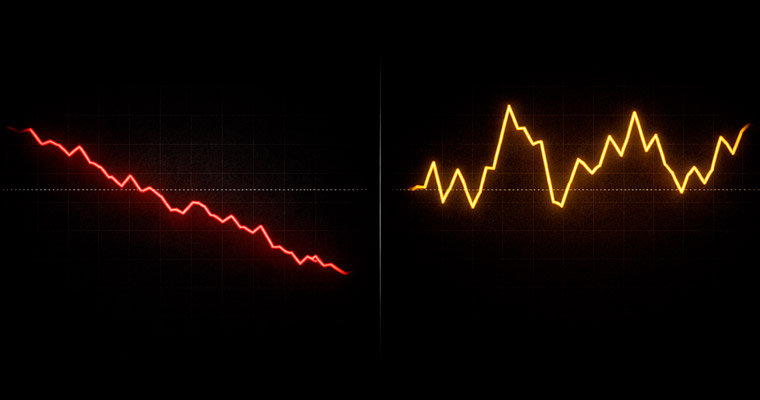
Fair pricing removes negative drift. It does not remove the distribution of possible results.
| Question | Answer | Mathematical Reason |
|---|---|---|
| Can a fair session finish down? | Yes. | Expected value is an average across possible outcomes, not a guaranteed result. |
| Does playing longer guarantee break-even? | No. | Dispersion grows with the square root of the number of bets. |
| Can a finite bankroll eventually reach zero? | Yes. | In an idealized fair unit-stake game with no upper stop, eventual ruin occurs with probability 1. |
| Does a smaller stake improve RTP? | No. | It creates more bankroll units and smaller currency swings, but the expectation per dollar is unchanged. |
| Are all 100% RTP games equally risky? | No. | The same expectation can be paired with very different outcome variance. |
This page deals only with variance, drawdowns and ruin risk. For the definition and expected-value formulas, read What Does 100% RTP Mean?. For allowance and post-cap pricing, use Zero-Edge Allowance Explained.
Fair Expectation Does Not Mean a Flat Balance
For a simple fair even-money game, each one-unit bet has two possible net results:
- win: +1 unit;
- loss: −1 unit.
Each result has 50% probability, so expected net profit is zero. After n bets:
Net = Stake × (2 × Wins − n)Standard deviation
SD = Stake × √nThe expected result remains zero, but the typical distance from zero increases as the number of bets grows.
How Often Does a Fair Session Finish Down?
In an even number of fair even-money bets, three endings are possible: profit, exact break-even or loss. Profit and loss have equal probability. As the sample becomes larger, exact break-even becomes less likely, so the probabilities of finishing up and down each approach 50%.
| Number of Bets | Chance of Finishing Down | Chance of Exact Break-Even | Chance of Finishing Up |
|---|---|---|---|
| 10 | 37.70% | 24.61% | 37.70% |
| 50 | 44.39% | 11.23% | 44.39% |
| 100 | 46.02% | 7.96% | 46.02% |
| 1,000 | 48.74% | 2.52% | 48.74% |
More bets make the observed return more stable as a percentage of turnover, but they do not make a losing final balance impossible. In this symmetric example, the probability of finishing below the starting point moves toward 50%, not toward zero.
Approximate Session Ranges
For fair even-money bets, an approximate 95% range is:
Expected result ± 1.96 × Stake × √Number of bets
| Session | Stake | Expected Result | Standard Deviation | Approximate 95% Range |
|---|---|---|---|---|
| 50 bets | $10 | $0 | $70.71 | About −$139 to +$139 |
| 200 bets | $10 | $0 | $141.42 | About −$277 to +$277 |
| 1,000 bets | $10 | $0 | $316.23 | About −$620 to +$620 |
| 200 bets | $100 | $0 | $1,414.21 | About −$2,772 to +$2,772 |
This approximation applies to independent fair even-money outcomes. Crash, Mines, Plinko and low-probability Dice settings can have substantially different distributions.
A Specific Streak Is Not the Same as a Streak Somewhere
The probability that one chosen block contains k consecutive losses is:
P(specific loss block) = Loss probabilityk
Across a longer session, there are many overlapping opportunities for the streak to occur. The probability of seeing it at least once is therefore much higher.
| Setting | Streak | Probability for One Specific Block | Probability at Least Once in 100 Bets |
|---|---|---|---|
| 50% win chance | 6 losses | 1.5625% | 54.61% |
| 50% win chance | 10 losses | 0.0977% | 4.41% |
| 10% win chance | 20 misses | 12.16% | 77.53% |
| 5% win chance | 20 misses | 35.85% | 98.21% |
| 5% win chance | 40 misses | 12.85% | 48.97% |
The “at least once” values account for overlapping runs. Simply multiplying the one-block probability by the number of possible starting positions would overcount some sequences.
Why Low Win Chances Create Wider Swings
Consider a fair binary bet with win probability p and gross multiplier 1/p. For a one-unit stake, the variance of net profit is:
Variance = (1 − p) / p
The standard deviation per bet is therefore:
SD = √((1 − p) / p)
| Win Chance | Fair Gross Multiplier | Standard Deviation per 1-Unit Bet | Risk Pattern |
|---|---|---|---|
| 50% | 2x | 1.00 unit | Frequent wins and losses |
| 25% | 4x | 1.73 units | Longer losing runs |
| 10% | 10x | 3.00 units | Most bets lose; occasional larger return |
| 5% | 20x | 4.36 units | Extended dry spells are normal |
| 1% | 100x | 9.95 units | Extreme dispersion around the same zero EV |
All five bets can be 100% RTP. They are not equally volatile.
Gambler’s Ruin in a Fair Game
In the idealized symmetric random walk, a player starts with a finite number of bankroll units, wins or loses one unit per round, and stops at zero.
If the player instead stops at either zero or a fixed upper target B, starting from i units:
P(target first) = i / BProbability of ruin before the target
P(ruin first) = 1 − i / B| Starting Bankroll | Upper Target | Chance of Reaching Target First | Chance of Ruin First |
|---|---|---|---|
| 100 units | 150 units | 66.67% | 33.33% |
| 100 units | 200 units | 50.00% | 50.00% |
| 100 units | 300 units | 33.33% | 66.67% |
This model assumes independent 50/50 outcomes, one-unit gains and losses, no ties, no limits and no edge. It illustrates why a neutral expectation is not a bankroll guarantee.
Bet Size Changes Bankroll Units, Not RTP
A useful exposure measure is:
Bankroll units = Bankroll ÷ Stake
| Bankroll | Stake | Bankroll Units | Consecutive Full Losses to Zero |
|---|---|---|---|
| $500 | $5 | 100 | 100 |
| $500 | $10 | 50 | 50 |
| $500 | $25 | 20 | 20 |
| $500 | $50 | 10 | 10 |
| $500 | $100 | 5 | 5 |
The last column is not a prediction of ruin; real paths mix wins and losses. It shows how quickly a short uninterrupted loss run can consume the balance. No percentage of bankroll makes gambling safe.
What Bet Management Can and Cannot Change
| Action | What It Changes | What It Does Not Change |
|---|---|---|
| Reduce fixed stake | Currency variance and number of bankroll units | RTP or expected value per dollar wagered |
| Choose a higher win chance | Outcome frequency and volatility | RTP when the multiplier remains fairly calibrated |
| Use a loss progression | Timing and concentration of exposure | The underlying expectation |
| Set a session loss limit | Maximum planned session exposure | The odds or RTP of each round |
| Set an upper stopping target | When the session ends and target-before-ruin probability | The fairness of the game itself |
What Changes Below 100% RTP
At lower RTP, variance remains and a negative expected drift is added:
Expected result = −Turnover × House edge
| Turnover | 100% RTP | 99.9% RTP | 99% RTP | 97% RTP |
|---|---|---|---|---|
| $10,000 | $0 expected drift | −$10 expected drift | −$100 expected drift | −$300 expected drift |
| $50,000 | $0 expected drift | −$50 expected drift | −$500 expected drift | −$1,500 expected drift |
Fair pricing is materially better because it removes systematic cost. It does not remove the random path around expectation.
Limits Can End the 100% RTP State
A page or interface may correctly show 100% RTP only for a defined state. Effective return can change when:
- a zero-edge allowance is exhausted;
- an instant return stops;
- a maximum-win cap truncates a payout;
- a strategy-dependent game is played incorrectly;
- a different game mode or paytable is selected.
That distinction belongs to the game and account audit. It does not change the variance mathematics described above.
How to Check a Losing Session
- Confirm the game state: verify that the advertised RTP applied to the tested bets.
- Check the paytable: confirm that payouts match the claimed probability model.
- Calculate turnover: compare the session result with total wagering, not only the deposit.
- Identify volatility: record win chance, target multiplier or game risk setting.
- Compare with plausible ranges: use the correct distribution, not only average RTP.
- Verify completed outcomes separately: use provably fair data where supported.
A loss does not prove manipulation, and a win does not prove fair pricing. Outcome integrity and RTP must be checked separately.
Related RTP and Risk Guides
- What Does 100% RTP Mean? — RTP, edge and expected-value definitions.
- House Edge Cost — expected cost by turnover.
- Zero-Edge Allowance Explained — tracker, reset and post-cap state.
- How Zero Edge Works — implementation mechanisms and payout caps.
- Provably Fair Checker — verify supported completed outcomes.
Frequently Asked Questions
Does 100% RTP guarantee that I eventually recover a loss?
No. The expected result is neutral, but a finite bankroll can reach zero and an individual session can remain negative.
Why does the chance of finishing down approach 50%?
In a symmetric fair even-money model, profitable and losing outcomes have equal probability. As the number of bets grows, exact break-even becomes less likely.
Can a fair game eventually bankrupt a finite bankroll?
Yes. In the idealized unit-stake random walk with unlimited play and no upper stopping point, eventual ruin occurs with probability 1.
Does lowering the stake improve expected value?
No. It reduces currency-sized swings and creates more bankroll units, but expected value per dollar wagered remains unchanged.
Why are low-win-chance bets more volatile?
Fair pricing requires a larger payout to compensate for less frequent wins. That produces a wider distribution of net results.
Does a losing streak prove that a game is rigged?
No. Streaks can be ordinary under the stated probabilities. Verify the paytable and completed outcomes before drawing a conclusion.
Is a 100% RTP game safe?
No. It removes theoretical house-edge cost under defined conditions, not variance, behavioral risk, platform risk or the possibility of losing the entire balance.
Bottom Line
100% RTP removes negative expected drift. It does not force a session to break even, prevent long loss runs or protect a finite bankroll from ruin.
The practical risk depends on the outcome distribution, stake size, bankroll units, stopping rules and whether the advertised fair-return state actually applies. Fair pricing lowers mathematical cost; it does not make gambling safe.