Duel vs Gamdom: Which Is Better?
Duel currently exposes the larger checked Zero Edge allowance. Gamdom now has a clearly documented $5,000 daily effective-100% band, but its wider first-$50,000 and personalised rewards documentation still requires separate interpretation.
Five Layers Compared Separately
Outcome integrity, game pricing, account rewards and platform safety are different questions.
For the standalone platform audits, see the Duel Casino Review and Gamdom Casino Review. This page focuses on the head-to-head comparison. For current game-by-game availability across both platforms, use 100% RTP game availability by casino.
Duel vs Gamdom in One Minute
| Question | Current Answer | Reason |
|---|---|---|
| Which is easier to audit before betting? | Duel on simple eligible Originals. | Allowance state, displayed edge and formula can be checked directly. |
| Which has the larger confirmed daily Zero Edge band? | Duel. | The checked states were $50,000 daily at Duel versus $5,000 daily at Gamdom. |
| Which has the stronger operating-history argument? | Gamdom. | It has a longer public record than Duel. |
| Which publishes broader verifier examples? | Gamdom. | Its Help Center links sample code for seven Originals. |
| Which has stronger regulatory protection? | Neither. | Both use Anjouan offshore licensing. |
Head-to-Head Comparison
| Category | Duel | Gamdom |
|---|---|---|
| Current operator | Immortal Snail LLC | Moon Revolution Limitada |
| Published licence | Anjouan ALSI-202411026-FI1; official register currently lists duel.com as valid through November 3, 2026 | Anjouan ALSI-152406043-FI, published in official Terms and Help material |
| Best model description | $50,000 daily Zero Edge allowance with game-specific base implementations | $5,000 daily Zero Edge band plus separate wider hybrid rewards / first-$50K documentation |
| Current confirmed Zero Edge volume | $50,000 daily; $1,000 qualifying single-bet limit in the checked account | $5,000 daily across in-house games in the checked account and current KOTH wording |
| Return calculation | Dice check: 99.90% base RTP + 0.1% instant rakeback while eligible; other Originals can differ | First $5,000: 99% base + 1% Instant Rakeback = 100% effective RTP; wider rewards remain account-specific |
| After confirmed Zero Edge band | General FAQ says the 0.1% return stops until reset; game-specific post-limit pricing remains relevant | Checked panel stated 1% house edge / 99% RTP; separate first-$50K wording may add other rewards/returns |
| Complex-game exception | Original Blackjack uses a separate 0.10%–0.57% scaling edge; Original slots use scaling post-allowance edge | Reward generation depends on game RTP, house edge and undisclosed account factors |
| Explicit fair-return game scope | Eligibility must be checked through the live game and allowance state | Dice, Plinko, Mines, Keno, Pocket Dice and HiLo named in the RTP-and-rewards section |
| Provably fair system | Game-specific seed verification using server-side and client-side inputs | Reverse SHA-256 chains of 10 million hashes plus published sample calculation code |
| KYC position | Published policy references aggregate lifetime deposits above EUR 5,000 and withdrawal requests | Usually not required initially, but several verification levels can be requested and withdrawals can be disabled pending completion |
| Operating history | Newer public record | Longer public record |
| Main audit risk | Assuming one allowance rule covers Blackjack, slots and every Original | Adding promotional or personalised rewards to RTP without measuring actual value |
The Core Difference: Allowance Size and Evidence Layers
Duel’s checked Zero Edge state is larger: $50,000 of daily eligible turnover with a $1,000 qualifying bet limit. In Dice, the live game screen showed 49.95% win probability at 2.0000x, equal to 99.90% base RTP, while the account layer supplied the 0.1% Zero Edge offset.
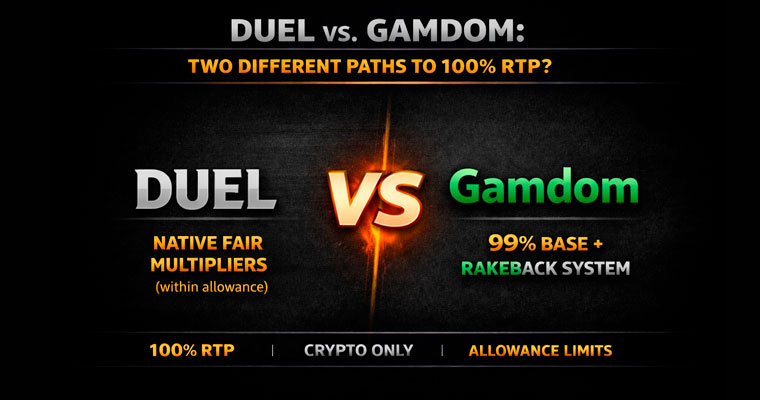
Gamdom’s checked daily Zero Edge band is $5,000 across in-house games. The current KOTH Help Center says this volume runs at effective 100% RTP with 1% value returned through Instant Rakeback. A separate Originals article still describes around 99% RTP, rewards and a small instant return on certain games for the first $50,000 wagered.
Effective RTP = 99.90% base RTP + 0.10% eligible instant return = 100%Gamdom checked $5K band
Effective RTP = 99% base RTP + 1% Instant Rakeback = 100%The important difference is no longer “fixed return versus no fixed return.” Both platforms have a directly described Zero Edge state. Gamdom simply retains an additional wider rewards/documentation layer that must be audited separately.
Worked Cost Example: $10,000 Turnover
| Scenario | Confirmed Zero Edge Portion | Post-Band Base Cost | Expected Cost Before Other Rewards |
|---|---|---|---|
| Duel Dice, checked allowance active | All $10,000 remains inside the $50,000 daily allowance | None in this example | $0 under the stated 0.1% offset model |
| Gamdom in-house play | First $5,000 at effective 100% RTP | Next $5,000 at the checked 1% edge / 99% RTP state | $50 before any separate wider rewards or first-$50K return mechanics |
Allowance Scale Comparison
| Platform | Confirmed Daily Zero Edge Band | Checked / Published Post-Band Reading | Main Caveat |
|---|---|---|---|
| Duel | $50,000 | General FAQ: 0.1% return stops; Dice base pricing is 99.90% | Other Originals can expose different base settlement paths |
| Gamdom | $5,000 | Checked panel: 1% house edge / 99% RTP | Separate first-$50,000 Originals and personalised rewards wording remains unresolved |
Eligible Games: Corrected Scope
| Game | Duel | Gamdom | Comparison Note |
|---|---|---|---|
| Dice | Formula-driven Original; allowance and displayed multiplier matter | Included in current in-house $5K Zero Edge scope; also named in first-$50K Originals wording | Best direct multiplier comparison |
| Mines | Combinatorial multiplier plus seed-based board check | Explicitly named; sample verifier code published | Compare native table before rewards |
| Plinko | Lane probabilities and risk-mode table | Explicitly named; sample verifier code published | Complete table required on both |
| Keno | Live paytable and risk mode required | Explicitly named; sample verifier code published | Hypergeometric probability audit |
| Crash | Audited as a core Original, subject to current game state | Included in current in-house $5K Zero Edge scope; not named in the narrower first-$50K RTP-and-rewards list | Do not assume identical reward treatment |
| HiLo | Not part of the current main Duel audit set | Included in current in-house $5K Zero Edge scope and named in the narrower first-$50K list | Gamdom advantage in documented game scope |
| Pocket Dice | No equivalent audited Duel Original | Explicitly named; sample verifier code published | Gamdom-specific product |
| Blackjack | Current Original has a published 0.10%–0.57% scaling edge | Not named in the current Originals article reviewed here | Older lists should not be used as current evidence |
| Video Poker, Castle Roulette, Groomer’s Van | Distinct Duel Originals requiring separate audits | No direct product equivalence | Roster size does not imply stronger RTP evidence |
Provably Fair Comparison
| Verification Layer | Duel | Gamdom |
|---|---|---|
| Commitment structure | Game-specific server seed, client seed and nonce-style inputs | Reverse SHA-256 chains generated from a secret server seed |
| Public implementation detail | Fairness pages and game-specific verifier flows | Help Center links sample code for Roulette, HiLo, Dice, Plinko, Mines, Keno and Pocket Dice |
| Best use | Reproduce a completed account-specific result | Check hash-chain continuity and reproduce supported completed results |
| What it does not prove | Allowance eligibility, game RTP, KYC or withdrawal safety | Reward value, game RTP, KYC or withdrawal safety |
Gamdom has the broader set of publicly linked sample implementations. Duel has the simpler combined audit on selected games because formula, current edge and completed outcome can be checked within the same workflow.
Licensing, KYC and Account Risk
| Risk Area | Duel | Gamdom |
|---|---|---|
| Licence evidence | Current official Anjouan register entry for duel.com and ALSI-202411026-FI1 | Operator Terms and Help Center publish ALSI-152406043-FI |
| KYC trigger wording | Policy references aggregate lifetime deposits over EUR 5,000 or a withdrawal request | KYC is usually not required unless requested, but can be triggered by compliance, promotions or account review |
| Verification depth | Identity and source-of-funds checks may apply | Level 1 personal data, Level 2 ID/selfie, Level 3 proof of funds and possible proof of address |
| Withdrawal restriction | Do not assume document-free withdrawals | Official Help Center says withdrawals may be disabled until requested checks are completed |
| Track-record signal | Shorter public history | Longer public history |
Gamdom’s longer operating record is a relative strength, not proof that a specific withdrawal will be processed. Duel’s current public-register licence entry is a relative documentation strength, not top-tier regulatory protection.
Category Verdict
| Category | Advantage | Reason |
|---|---|---|
| Simple-game effective RTP transparency | Fixed allowance return and displayed game state are easier to calculate. | |
| Confirmed Zero Edge allowance size | $50,000 daily at Duel versus $5,000 daily at Gamdom in the checked states. | |
| Public verifier examples | Seven game calculation examples are linked from the Help Center. | |
| Operating history | Longer public record. | |
| Broader rewards and product ecosystem | Instant, weekly, monthly and rank rewards across a larger ecosystem. | |
| Licence documentation checked in public register | Current duel.com entry and expiry were independently visible in the regulator register. | |
| Top-tier regulatory protection | Both rely on Anjouan offshore licensing. |
Which Model Fits Which Player?
Duel May Fit Better When:
- the main goal is auditing Dice, Mines, Crash, Plinko or Keno math;
- you want to know the return state before placing the bet;
- you prefer a fixed account allowance mechanism over personalised rewards;
- you are prepared to monitor post-allowance and game-specific edge changes;
- you accept a newer offshore operator and possible KYC.
Gamdom May Fit Better When:
- you want a clearly defined $5,000 daily Zero Edge band alongside a broader rewards ecosystem;
- you value HiLo, Pocket Dice and wider published verifier examples;
- you actively use instant, weekly, monthly and rank rewards;
- you are willing to calculate realised return from actual account credits;
- you accept offshore terms and multi-level KYC if requested.
Frequently Asked Questions
Which is better, Duel or Gamdom?
Duel is stronger for simple-game RTP transparency. Gamdom is stronger for operating history, ecosystem breadth and public verifier examples. Neither is universally better.
Is Duel natively 100% RTP?
Not across every product. Simple eligible games can reach 100% effective RTP through the allowance return, Original slots have separate economics, and Original Blackjack uses a scaling 0.10%–0.57% edge.
Is Gamdom 100% RTP?
The current evidence supports effective 100% RTP for the first $5,000 of daily in-house wagering through 1% Instant Rakeback. After that band, the checked account panel showed 99% RTP / 1% house edge.
How does Gamdom’s first $50,000 wording fit the $5,000 daily band?
It comes from a separate Originals article describing around 99% base RTP plus rewards and a small instant return on certain games. Gamdom does not currently document the relationship clearly enough to merge the two descriptions into one tier structure.
Which has better provably fair verification?
Gamdom publishes sample code for more named games. Duel provides a more direct combined audit on selected simple games because the current edge and payout formula can also be inspected.
Which is safer for withdrawals?
No universal conclusion is supportable. Gamdom has a longer operating record; Duel has a current licence entry visible in the public register. Both can request KYC and should be tested with a small withdrawal.
Can I compare the advertised reward percentages directly?
No. Convert each reward into cash-equivalent value divided by eligible turnover. Gamdom’s headline reward boosts apply to its personalised reward component, not automatically to total turnover.
Bottom Line
Duel and Gamdom both now have a directly evidenced Zero Edge state. Duel’s checked band is much larger at $50,000 daily, while Gamdom’s checked band is $5,000 daily. The more important difference is what sits around those bands: Duel has game-specific base implementations, while Gamdom also maintains separate first-$50,000 Originals and personalised rewards documentation.
Use the live allowance state rather than the marketing label. On both platforms, keep base game RTP, account-level return, provably fair verification, KYC, licensing and withdrawals as separate audits.
Compare live terms before depositing. Both links below are affiliate links.
Better fit for simple-game RTP transparency and visible allowance state.
Check Duel Live TermsBetter fit for operating history, wider rewards and broader casino ecosystem.
Check Gamdom Live Terms18+ · verify local legality, eligible games, current licence, KYC, reward and withdrawal rules.